All posts by REB

Always Say Yes to Dancing Barefoot in a Fountain

I’m finally starting to get settled after Echo. One of the problems with doing performance gigs where I use my computer for projections is that my whole work area (home/studio) becomes completely savaged, with much of my stuff moved off-site. Sure, I tote my laptop with me to the performance venue and then back home, but there are all the other things that get unplugged and shuffled about. This time around one of my tables was removed (it’s a very handy adjustable DJ table). And the external video card which allows me to use all these three computer monitors was away. My audio interface, also elsewhere. And even afterwards, with everything back home, I’ve been too lazy to reconfigure the whole array. But finally, over the weekend, I have my work station back in shape.

So now I have all sorts of diversion to keep me from doing all of the projects hissing for my attention. I spent several hours this morning with Ableton Live video tutorials. Also, I migrated my website from www.rebosse.com to erikbosse.com (my namesake domain came back on the market, and I snapped it up).

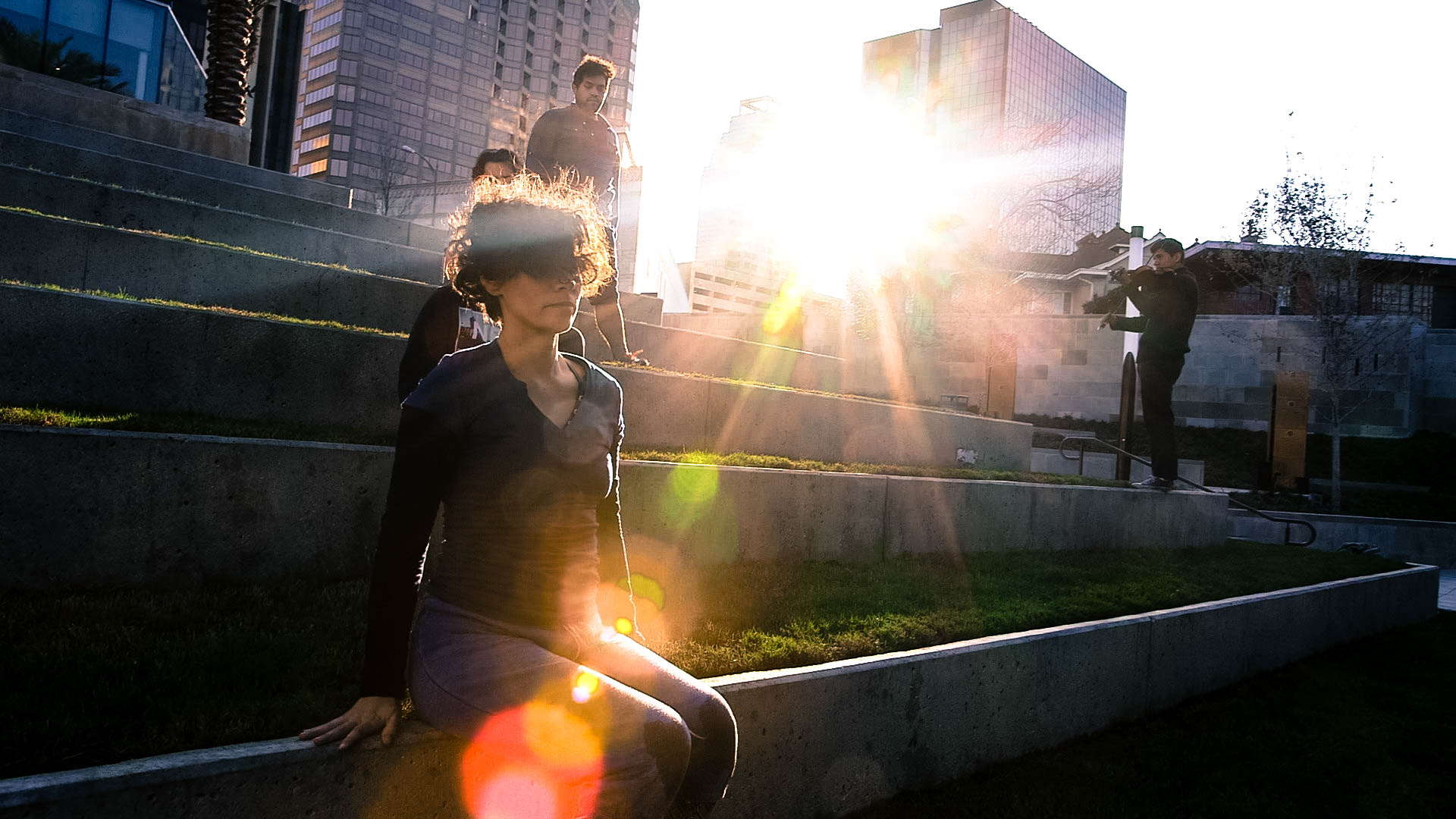
What I really need to be doing is to edit the footage from the other day when Amber, Charles, Eric, and Adan wandered around downtown, staging impromptu dance performances as part of Amber’s “Taken In Arms” project. They were dancing. I was shooting.

Then there’s the Mandala Healing Arts Project, which Deborah is running. I’m on board to create a series of videos to be informed by the participants. Deborah and I should be busy working on storyboards. Maybe Saturday.

I can’t forget the promotional video for the San Antonio Dance Umbrella. It should be simple and short. But last week I interviewed about ten people. There’s a lot of information to sift through. (And, I believe I need to do a final interview.)

Gemini Ink is expecting a finished edit soon from an event they had several days back which I shot.

Also, Serpientes y Escaleras. This is a play I need to start writing. The script is due the second week in January.

But, ’tis the season for procrastinators. This holiday period (for good or bad) is a nice time to hide from the world and all those pesky responsibilities.

@@@@@@

Taken In Arms is a portable, modular dance work created by Amber Ortega-Perez. She work-shopped a portion of the piece back in 2013 (I believe) at the W-I-P. At some point she asked if she could include me in a grant proposal. I love Amber and the wonderful work she creates, so of course I responded with an enthusiastic “yes!” The grant she was after was from the Artist Foundation of San Antonio. Back in late January of this year it was announced that she had won the grant in the dance category. My role in the project was to create a film of some of the portions; provide live video projection work during those performances in suitable venues; and to provide some documentation of the process and presentations.

We jumped into things very quickly. In February we shot some scenes of dance at Mission San Juan, and also near the Guadalupe Cultural Arts Center. The first performance with dance and projection was at the Blue Star Arts Complex on March 8th for the Artist Foundation’s MAP (Moveable Art Party). I also included part of Taken In Arms as one of my rotating community artist portions of my play, Tales of Lost Southtown, staged during March. There was another short performance during W-I-P Créme, held back in the spring at Say Sí. (There was also a staging of one of the modules for the 8×8 showcase at Jump-Start in June, but it didn’t involve any video work.) In late September we took the piece on the road and staged some of it at the 254 Dance Festival in Waco.

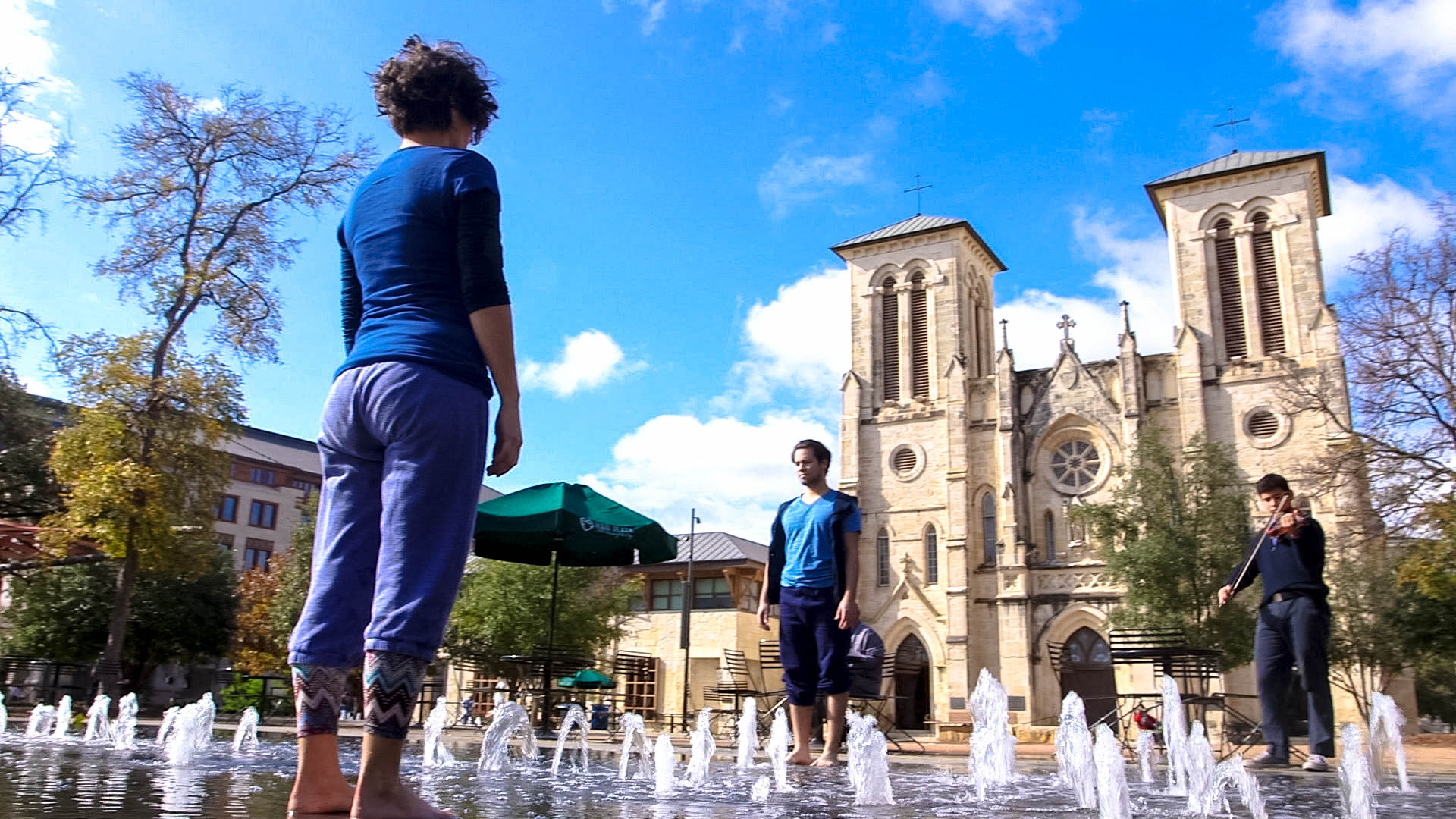
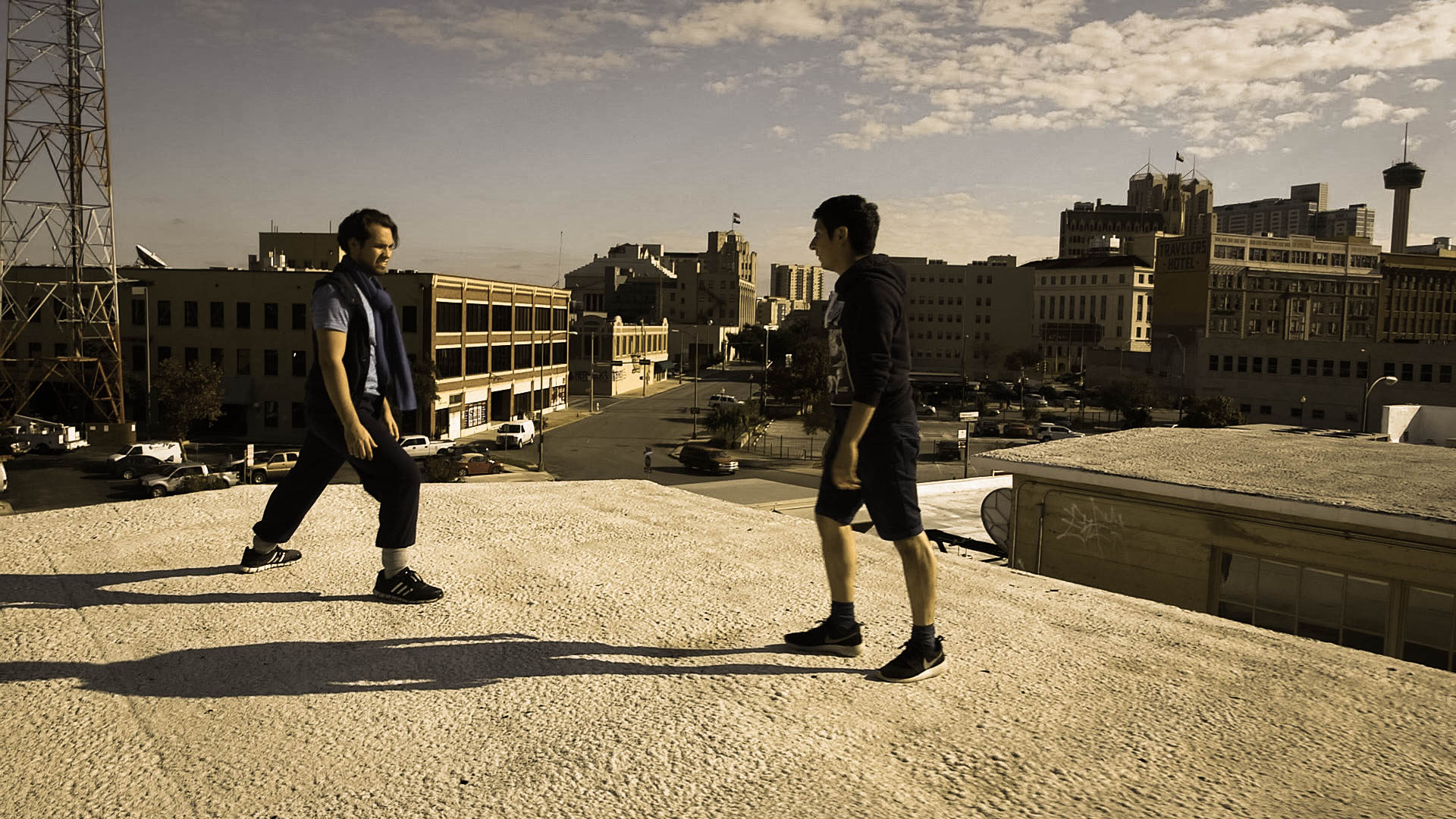
On Friday (Dec. 19th) we closed the project with some impromptu public appearances (though I’m encouraging Amber to have a wrap-up event so as to squeeze out a bit of media coverage). The performers have changed over the months for various reasons. Friday, we were Amber, Charles, Eric, and Adan. Amber’s son, Topi, was there with his violin to provide music. I had my trusty C100 on a monopod. We began at HemisFair Park, hitting two sites. Next, we headed to Main Plaza, where the dancers took off their shoes and began rehearsing in one of the fountains. It was a perfect day. Blue skies and in the 70s. I also took off my shoes so that I could be in the fountain with them as they performed. I always like shooting in water. Three other locations we hit before the end of the day was a courtyard at the Southwest School of Art, the roof of the Radius Center, and the River Walk side of the Tobin Center.

Here are some screenshots from the day. I’m experimenting with some color correction schemes.

mainmodradmodtobmod

I’m glad I was allowed to play with all the people involved in Taken In Arms. Some I’ve worked with before, others were completely new to me. And it’s always encouraging to leave a project wanting to work with all involved in the future. Thank you so much, Amber Ortega-Perez, Charles Perez, Jenny Been Franckowiak, Eric Flores, Adan Alarcon, and Laura Beth Rodriguez.

Echo

It might have been back in January of this year as I was pulling my trash can to the curb when my neighbor shouted to me, “Erik, congratulations on winning those Artist Foundation awards!” I was a bit taken aback because I hadn’t applied that year. But my neighbor was on the board of the Artist Foundation and should know best. I was fairly sure that one of the awards she was speaking of had been given to Amber Ortega-Perez. Amber had mentioned that she was placing my name on her application as a collaborator. But, what else? I eventually learned that Julia Langenberg, the aerialist, had also attached me to her application.

The project with Amber (“Taken in Arms”) began several months back. It’s a series of modularly devised inter-connected dance pieces. My contribution changes, depending on the location. I’m either filming the movements, or I’m providing the projection of live camera work as well as pre-recorded material. Amber has one last iteration of Taken in Arms to be staged in five locations throughout the day this Friday (yikes! that’s tomorrow!) around downtown San Antonio.

I’ve worked with Amber in one way or another for at least five years (I shot her 2009 performance of The Willing), and so we had already formed a working relationship and a sense of one another’s aesthetics. And, really, I don’t do work-for-hire (which is one of the reasons I’m always poor). I prefer working with people whom I’ve built a mutual mesh of trust and respect. However, I’d seen Julia’s work at Luminaria, the W-I-P, and the Guadalupe, so I had some idea of what I was getting into. The real sticking point was the venue in which the work would be staged. Julia’s studio was inside an event facility which used to be Jump-Start Performance Co., before the entire Blue Star “arts” complex went to shit, and Jump-Start was forced out. I mentioned my general sour attitude to Julia, but told her I’d rise above my petty animus and commit to the project.

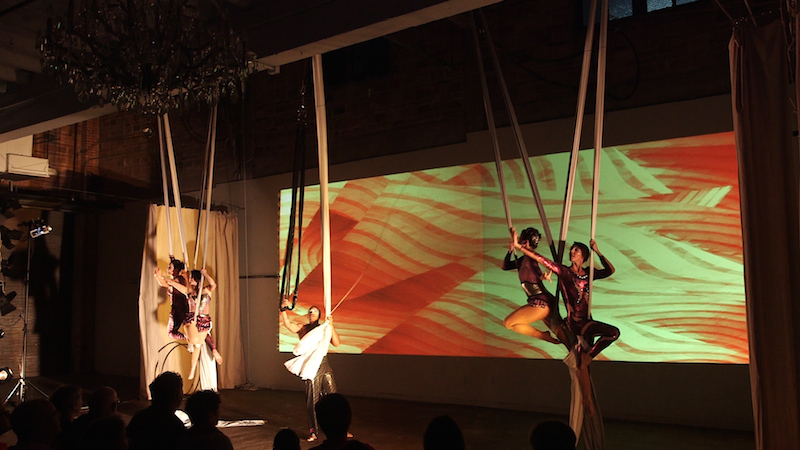
Echo evolved into a fairly large production of six aerialists, six musicians, a lighting designer / board operator, and a video projection crew of two.

echographicdetail

Putting aside the (very considerable) artistry of all involved, one of the best things about the experience was to see the solid work-ethic demonstrated by Julia and her aerialists. Also, Jaime and his musicians. I must confess that I’ve become terribly discouraged by the flaky nature of so many of the people I’ve meet in the film and theater scene in town. But, for the most part, Echo was a smoothly run production with some wonderful people. It was also beautiful.

My part in this managed to escalate each time I opened my mouth. Usually saying something like, “Yeah, we can do that.”

There’s a reason most of these visually sumptuous A/V presentations in town are staged by professional companies with scads of cutting-edge equipment and a brace of well-trained crew members. It can get fairly complicated. True, you can do amazing things with a laptop and a few consumer devices, but just about every new device you need will also need several other devices to make it play nice with all the other tech. (“What’s that you say? You wanna run a GoPro video signal into your MacBook? You’ll need this Blackmagic box. It’s a steal at only $150. Oh, and it doesn’t come with the ThunderBolt cable. You’ll need one of those. Only $50.”)

This is one of the reasons I pulled in Trey Cunningham. He has much more experience in doing this. He also had projectors to rent. But, mostly, I wanted an opportunity to work with him.

We ended up using: four short-throw video projectors, one DVD player, two MacBook Pros, a Matrox TripleHead2Go, an HDMI wireless transmitter/receiver, a GoPro, a Panasonic DVX, a Blackmagic UltraStudio recorder, a Korg Nano Kontrol, and a Belkin thunderbolt dock; the data was sent over various cables such as SVGA, ethernet, coaxial, and of course that HDMI wireless transmitter; the software used was Modul8, Resolume, and SIGMASIX Syphoner. And because of the nature of the venue (the less said about that the better), I was breaking down everything except the projectors and the data cables every night after rehearsals and performances. The upside to this, is you develop a deeper understanding of the tech and (at least for me) an increased level of confidence if anything starts to go awry.

echocokpit

It was the most involved and kludged-together setup I’ve yet had to devise. And because of that, I learned quite a bit.

Here are some stills taken from the video documentation shot by Destiny Mata.

fechosm

secho2

techo2

I had fun shooting some of the textures which I ran through Resolume. I used my motorized Kessler slider to shoot closeup tracking footage of brown rice, lentils, split peas, and various dried beans. I also clamped a GoPro to one of the aerial apparatuses (the double halo) to get some dynamic footage of Teddy spinning above ground. I employed After Effects for some of the animation. And I used Motion’s optic flow for the poor man’s morphing effects.

Now, off to the next series of projects….

Teddy and the GoPro

A version of this found itself into the over-all video design for Julia Langenberg’s Echo, an evening of aerial dance with live music (composed by Jaime Ramirez) and live video projection (provided by me) which was staged in a Blue Star venue on December 11, 12, 13, 2014. The performer on the double halo is Elise “Teddy” Sipos. (I should point out that the music here is really sped up from Jaime’s score). The video was shot by using a GoPro mounted to Teddy’s apparatus. I composed the layers in Resolume and then exported the video. I like the shifting images of wood to convey a sense of vertigo.


Kerrville’s Zombie Infestation

I’m presently in a state of low level anxiety because of all the projects I have initiated, and others which I have committed to. This is all compounded by the fact that none are, as yet, terribly pressing, so I just keep letting much of these things slide, trying not to think about the wave which will crash sooner or later.

One of the bigger projects is Echo, a performance work being created by a San Antonio-based aerialist. I was somewhat taken aback when I learned some months ago that I had been attached to her Artist Foundation grant proposal. I am expected to provide video design and such.

With these sorts of presentations, I find myself spending dozens of hours just trying to figure out the best manner to set up the tech. We’re talking about live media manipulation, live camera feeds (probably two), multiple projectors (perhaps as many as four), and a fair amount of projected pre-recorded material. I’ve been trying to find the best way to get a camera signal to my laptop which I’d prefer to have set up at the back of the venue. A wireless HDMI transmitter sounds nice. My hope is to place a GoPro up on a rigging in the high ceiling and down to my computer. I’ll have to compress the signal with a BlackMagic encoder. But now another problem. My Mac Book Pro has only one Thunderbolt port. I need this to bring in the wireless signal. But the port is already being used for my output to the projectors. Now I could buy a new computer (those new MBPs have two ports), but I’m already pissing away tons of money into wireless transmitters, encoder dongles, and cables. So, I’m experimenting with networking two MBPs together and use a Syphon program to import the camera images into my VJ software. What an ordeal. So, once I get the whole workflow figured out, I can start shooting and editing the imagery.

@@@@@@

I had hoped that by now I would have wrapped work on the San Antonio segment of Gustavo Stebner’s newest Wappo project (a short web series to help promote a feature film). The other week we shot a couple days of scenes on downtown streets, a makeup studio, a River Walk restaurant, at a magician’s sideshow act, and at a cabin on some zombie-infested ranch outside of Kerrville. At some point in the weeks ahead we’ll pick up the scene with the San Antonio Film Commissioner. Drew had been unavailable earlier because he was in China, which is, of course, a great excuse.

Below are a few screen captures:

wcu

3shot

val

@@@@@@

Back in March just before the opening of my play, Tales of Lost Southtown, one of my co-stars, Pamela, gave me a little present. It was a Mexican version of Snakes and Ladders (or, properly, Serpientes y Escaleras) which she had picked up at Papa Jim’s Pet Shop and Botanica over on S. Flores. I loved the pastel illustrations of the game board, they had a style very reminiscent of those iconic Lotería cards.

I decided to create a play around the game. So, with Pam as a co-lead artist on this, we will produce it with Jump-Start Performance Co. in March of 2015. Laurie Dietrich will direct. She will also be helping in the writing of the script. It will be a devised work, created collaboratively by the cast. We’ve already begun to build the work. Expect to hear more about Jump-Start’s Serpiente’s y Escaleras in the weeks ahead. It will be fun, somewhat dark, and very strange.


Saved From the Silverfish

filllungs

I was commissioned to write a short piece for a collaborative event between Gemini Ink and the San Antonio Museum of Art, to highlight a show of Matisse’s book illustrations. I wrote a short story titled “Saved From the Silverfish.” Here it is:


SAVED FROM THE SILVERFISH

“It’s called Asylum Creek,” said the woman, Irma, who handed me a glass of iced tea. “On account of, you know, the State Hospital just up the road.” Irma turned and nodded at the pale woman with braids who sat on the sofa leafing through a used coloring book.

“Maisie here used to live there, at the State Hospital. Isn’t that right, Maisie?”

“C’est un peu vrai,” Maisie said softly, without looking up.

“Oh, it looks like she’s French, today.” Irma smiled and walked over to adjust Maisie’s braids so that they fell behind her shoulders. Maisie kept her attention focused on her coloring book.

“Well,” Irma said to me with a sigh, “I’ll leave you to it. Don’t mind Maisie. She’s a quiet one.”

I watched a sly smile flit across Maisie’s lips as Irma left. She turned a page and, without looking up, mouthed the words “C’est un peu vrai.”

There was a desk in the corner, and it was clearly set up for me. The gooseneck lamp was turned on, and a large Royal manual typewriter had been pushed aside. I placed my shoulder bag on a folding chair and set my laptop on the desk.

I’m not sure how Irma found my contact information. I’ve been out of the rare books appraisal business for at least five years. But I needed the money, and well, South Presa Street was not too far from home, so I said yes.

I walked up to the bookcases. There were five cases, each with five shelves. If soon became obvious there wasn’t much—the basic reprints of classics, mid-century fiction in book club editions, some later printings of art books. All in all, the sort of books one can find used on the internet for a few dollars each. There was one, however, which stood out. I instantly knew what it was, but I kept combing through the shelves, saving it for last. When I was done, I turned towards the middle bookcase and bent down to the bottom shelf. As I lifted up the large, slim volume, and placed it on the desk beside my computer, I heard Maisie clear her throat.

“Cela n’a pas pris longtemps,” Maisie said, placing her coloring book in her lap. “Nothing of much interest, right?” she continued in English, with a French accent. “Just that one. The obvious one.”

At that moment Irma walked in.

“Don’t let her throw you off,” Irma said, patting Maisie on the head. “Our little girl here grew up in a tiny town outside of Beaumont. She has an east Texas accent thick enough to march an alligator across. Poor child. Grew up in the bayous of Jefferson County, and then off to the San Antonio State Hospital after her daddy died. All the while her momma’s waltzing across Europe, Hawaii, and Cuba.”

I’m sure much of the juicy parts of the family history were left out, but from what I gathered, the mother came into some money and bought this little house to be close to her daughter. One day she moved Maisie out of the hospital and hired Irma to help out. Irma eventually found herself taking care of both mother and daughter. When the mother died, Irma stayed on. They’d been scraping by, barely making the monthly mortgage payments. Nothing much left, just a lot of furniture and kitchen appliances which were purchased back when avocado was a color. And, of course, the library.

Irma explained that she had some errands to take care of, but Maisie would be no trouble. Normally this is when I’d explain that there was really nothing of value, waive my consultation fee, give the names of a few local book dealers who might buy the lot on the cheap—and then, make good my escape. But there was the matter of that lone, slim volume.

I sat down at the desk. As I waited for my laptop to warm up, I saw Irma crossing over Asylum Creek in an old rusty Impala.

The book was a collection of poems by Charles d’Orleans. He was a 15th century French nobleman, the bulk of whose poetry was written as a prisoner of war in England. The book’s value has very little to do with the poetry of the Duke of Orléans. In fact, the selected poems are not even in their original state. The illustrator took it upon himself to rewrite the poetry into a more modern French. The book is notable because of the illustrator, Henri Matisse. Matisse provided 54 color lithographs, as well as some additional illustrations. The edition was limited to 1,200 copies, each signed by Matisse.

I know the book well. I had been working at an auction house in Dallas several years back and had written a description of a copy consigned by an elderly man from Pauls Valley.

Maisie pulled a chair next to mine and sat down. She ran her hand over the cover of the book. This collection of poems is not what everyone would recognize as a proper book. It is what is often referred to as “livre d’artiste,” that is, an artist’s book. The publisher, printer, typesetter, designer, bookbinder, all of them, worked to showcase the work of the artist—the text, often, being quite supplemental. Poèmes de Charles d’Orléans resembles more of an unbound portfolio. The front and back covers are stiff pasteboard, with an illustration on the front. This unattached cover (often referred to as a chemise) was wrapped in the publisher’s original glassine paper. The pages, inside, were loose gatherings, never bound by the publisher. Strictly speaking, it was not a rare book. If all the plates were present, and lacking any notable flaws, it was worth maybe four to six thousand dollars. Not enough for Irma and Maisie to make it through more than a couple of months, was my guess.

“I love this cover illustration,” Maisie said. “It looks like it was done by a child with crayons. I think Irma believes it’s one of my coloring books from when I was a girl.” She placed her hand palm down on the book and looked into my eyes.

“Charles d’Orleans was imprisoned by the English for 25 years. For me it’s been longer. Well, not by the English, you know. The doctors.”

I opened the book. On the preliminary limitation page, I saw Matisse’s familiar signature.  The letter “h” followed by a period. And “Matisse” was written out with a long “s” (crossed like an “f”) followed by a short “s.” But there was no printed number to identify this copy between 1 and 1,200. It’s what is called an out-of-series copy. Sometimes these were test copies where the printer was checking the general layout or various types of paper or ink. Often they served as proofs for the scrutiny of publisher or author. But mostly, they were extra copies to be used for any unforeseen contingencies. This copy wasn’t blank, however. Instead of a number, there was a small red heart inked with a broad nib in a hand firmer than that of an 80 year-old Matisse.

“It’s a heart,” Maisie said. “You know, for love.” And she pushed back her chair and left the room. I could hear her rustling around back in the kitchen.

I checked some reference material on my computer to see the proper pagination of the book, with the number of leavers and lithographs and other illustrations, and began the process of collating, making sure that the book was intact and complete. It didn’t take long. All was as it should be. At the back were three envelopes. I love finding things like that. It’s where things can get interesting. Before I could dig deeper, I heard Maisie return.

She wore an apron and set down a chipped Wedgwood platter with celery stalks stuffed with peanut butter and topped with green olives. “I would have brought the jam. But there were ants. So many ants.”

She wiped her hands on the apron, sat back down beside me, and gathered up the envelopes. “There’s a story that goes with these. And I thought you might want a snack.” She waited patiently, leaning in a bit towards me, her eyes wide and expectant. When I finally took a bite of one of the celery sticks, she began.

“Her name was Lilly, short for Lillian. It was 1943 and she was young, traveling alone through France. This was during the second world war. I think she was a spy. Irma says she was just a loose woman. I don’t know why she couldn’t have been both. But she was my mother, so I’ll never know the whole truth. Anyway, this is way before I came into the picture.”

Maisie lifted up one of the envelopes. She removed a crisp sheet of paper folded into thirds. She handed me the envelope and read from the letter. “Mon cher monsieur Tériade….” Maisie looked up. “How’s your French?” I shrugged, and shook my head. “Pity,” she said. “It’s from Fernand Mourlot. He did the lithography for this book. He and my mother were also lovers. It’s all in the letter. You have to read it right. He quotes some of Charles d’Orleans steamier couplets. Anyway, the letter is written to Tériade, who my mother said was a snake. Tériade published this book. He and Mourlot did all sorts of things together. They created Verve magazine. Verve. Hmm. Verve. That’s a sexy word in any language. Here he’s instructing monsieur Tériade to track down my mother and deliver this copy to her, heart and all. The book took a couple of years to get published and Lilly had moved on with her travels.”

Maisie opened the book to a page with a nude woman seated with her knees to her chest and holding her hair back with a hand.

“That’s my mama, Lilly. She would have been 19 when this was done. Here’s another picture of her.” She handed me the larger envelope.

I pulled out the original charcoal drawing of the print in the book. It was signed and dated by Matisse. Maisie tapped the back of the drawing. I turned it over. Even my poor French could translate “ma flour préférée, Lilly” as “my favorite flower, Lilly.” I noticed there was another piece of paper in the envelope. I pulled out a slip of pale blue paper with a one hundred franc note pinned to it. There was a short paragraph in ink on the paper.

“It’s Matisse explaining that he had forgotten to pay Lilly for the sitting. 100 francs? In the ’40s? What a cheapskate!”

Maisie handed me the final envelope. It was thicker than the others. I removed a folded panel of brown butcher paper which had clearly been used to wrap up the book for mailing. It had French stamps, a return address for a M. Tériade, in Paris, and was addressed to Lillian Calhoun, 7300 South Presa Street.

“I don’t know why the book took so long to find mama. I like to think detectives were employed. It arrived in the post while she was living here, running through a small inheritance with cheap wine, palm readers, and therapists. One day she cleaned out a little room in back and moved me out of my prison across the road at the State Hospital into this new prision here, on the creek.”

We heard Irma come in the back door. Maisie took the book and returned to her sofa.

“Not much of interest?” Irma asked, pointing to the wall of books. “I use her mothers cookbooks every now and then.” She looked over at Maisie. “I hope she wasn’t too much of a pest. She’s good one-on-one, but put two people or more in a room with her and she just shuts down. It’s not that hard to imagine. But for some reason, the doctors don’t even have a name for her condition. And all this talk about being in prison….” Irma shot Maisie a look. “Yes, Maisie, I know what you get up to when I’m not around. Anyway, don’t believe a word of it. She comes and goes whenever she wants, but she will never cross that creek.”

Irma sighed and ran a hand over the spines of some books on a shelf. “I was hoping that these would get us some money. I work when I can. And Maisie helps out, too. She cooks at least one meal a day for us. Isn’t that right, Maisie?” And then, quieter, but still loud enough for Maisie to hear. “And it’s awful.”

When Irma had left, I shut down my computer, gathered up my things, and told Maisie that she had a wonderful book and I thanked her for telling me about her mother and Matisse.

“It belongs to me,” Maisie said, holding the book tight against her chest.

“I know,” I said.

“I kept it safe all these years, saved it from the roaches and the silverfish.”

“You’re doing an excellent job of it,” I said. “You really are.” And I placed one of my business cards on the table beside the gooseneck lamp.

Maisie got up and walked over. She picked up the business card and returned it, and then she handed the book to me. I looked at her, but she just lowered her head and shrugged. So I walked into the kitchen to tell Irma that her life had changed. I wrote out a description of the book, the letters, and the original drawing by Matisse. I gave her the phone number of a friend who worked at Christie’s. “Tell him everything I’ve written. Mention my name. He’ll fly out and take it from there. He can call me if he needs to.”

I walked out. Maisie never looked up from the sofa. I got in my car, drove across Asylum Creek, over the railroad tracks, and then I turned left on South Presa Street.

I never did learn what Maisie’s affliction might have been. Certainty something more than just being, well, “French.”

I wonder what ever happened to them.
Saved From the Silverfish

I stood at the high bay windows looking out at the gravel road I had just drove on. I could see the creek, the railroad tracks, and, further out, the tree line, behind which ran South Presa Street. Three parallel lines. And back behind me was the San Antonio River. It was close, and I knew I would be able to see it, if there was another window there, instead of a row of bookcases.

“It’s called Asylum Creek,” said the woman, Irma, who handed me a glass of iced tea. “On account of, you know, the State Hospital just up the road.” Irma turned and nodded at the pale woman with braids who sat on the sofa leafing through a used coloring book.

“Maisie here used to live there, at the State Hospital. Isn’t that right, Maisie?”

“C’est un peu vrai,” Maisie said softly, without looking up.

“Oh, it looks like she’s French, today.” Irma smiled and walked over to adjust Maisie’s braids so that they fell behind her shoulders. Maisie kept her attention focused on her coloring book.

“Well,” Irma said to me with a sigh, “I’ll leave you to it. Don’t mind Maisie. She’s a quiet one.”

I watched a sly smile flit across Maisie’s lips as Irma left. She turned a page and, without looking up, mouthed the words “C’est un peu vrai.”

There was a desk in the corner, and it was clearly set up for me. The gooseneck lamp was turned on, and a large Royal manual typewriter had been pushed aside. I placed my shoulder bag on a folding chair and set my laptop on the desk.

I’m not sure how Irma found my contact information. I’ve been out of the rare books appraisal business for at least five years. But I needed the money, and well, South Presa Street was not too far from home, so I said yes.

I walked up to the bookcases. There were five cases, each with five shelves. If soon became obvious there wasn’t much—the basic reprints of classics, mid-century fiction in book club editions, some later printings of art books. All in all, the sort of books one can find used on the internet for a few dollars each. There was one, however, which stood out. I instantly knew what it was, but I kept combing through the shelves, saving it for last. When I was done, I turned towards the middle bookcase and bent down to the bottom shelf. As I lifted up the large, slim volume, and placed it on the desk beside my computer, I heard Maisie clear her throat.

“Cela n’a pas pris longtemps,” Maisie said, placing her coloring book in her lap. “Nothing of much interest, right?” she continued in English, with a French accent. “Just that one. The obvious one.”

At that moment Irma walked in.

“Don’t let her throw you off,” Irma said, patting Maisie on the head. “Our little girl here grew up in a tiny town outside of Beaumont. She has an east Texas accent thick enough to march an alligator across. Poor child. Grew up in the bayous of Jefferson County, and then off to the San Antonio State Hospital after her daddy died. All the while her momma’s waltzing across Europe, Hawaii, and Cuba.”

I’m sure much of the juicy parts of the family history were left out, but from what I gathered, the mother came into some money and bought this little house to be close to her daughter. One day she moved Maisie out of the hospital and hired Irma to help out. Irma eventually found herself taking care of both mother and daughter. When the mother died, Irma stayed on. They’d been scraping by, barely making the monthly mortgage payments. Nothing much left, just a lot of furniture and kitchen appliances which were purchased back when avocado was a color. And, of course, the library.

Irma explained that she had some errands to take care of, but Maisie would be no trouble. Normally this is when I’d explain that there was really nothing of value, waive my consultation fee, give the names of a few local book dealers who might buy the lot on the cheap—and then, make good my escape. But there was the matter of that lone, slim volume.

I sat down at the desk. As I waited for my laptop to warm up, I saw Irma crossing over Asylum Creek in an old rusty Impala.

The book was a collection of poems by Charles d’Orleans. He was a 15th century French nobleman, the bulk of whose poetry was written as a prisoner of war in England. The book’s value has very little to do with the poetry of the Duke of Orléans. In fact, the selected poems are not even in their original state. The illustrator took it upon himself to rewrite the poetry into a more modern French. The book is notable because of the illustrator, Henri Matisse. Matisse provided 54 color lithographs, as well as some additional illustrations. The edition was limited to 1,200 copies, each signed by Matisse.

I know the book well. I had been working at an auction house in Dallas several years back and had written a description of a copy consigned by an elderly man from Pauls Valley.

Maisie pulled a chair next to mine and sat down. She ran her hand over the cover of the book. This collection of poems is not what everyone would recognize as a proper book. It is what is often referred to as “livre d’artiste,” that is, an artist’s book. The publisher, printer, typesetter, designer, bookbinder, all of them, worked to showcase the work of the artist—the text, often, being quite supplemental. Poèmes de Charles d’Orléans resembles more of an unbound portfolio. The front and back covers are stiff pasteboard, with an illustration on the front. This unattached cover (often referred to as a chemise) was wrapped in the publisher’s original glassine paper. The pages, inside, were loose gatherings, never bound by the publisher. Strictly speaking, it was not a rare book. If all the plates were present, and lacking any notable flaws, it was worth maybe four to six thousand dollars. Not enough for Irma and Maisie to make it through more than a couple of months, was my guess.

“I love this cover illustration,” Maisie said. “It looks like it was done by a child with crayons. I think Irma believes it’s one of my coloring books from when I was a girl.” She placed her hand palm down on the book and looked into my eyes.

“Charles d’Orleans was imprisoned by the English for 25 years. For me it’s been longer. Well, not by the English, you know. The doctors.”

I opened the book. On the preliminary limitation page, I saw Matisse’s familiar signature.  The letter “h” followed by a period. And “Matisse” was written out with a long “s” (crossed like an “f”) followed by a short “s.” But there was no printed number to identify this copy between 1 and 1,200. It’s what is called an out-of-series copy. Sometimes these were test copies where the printer was checking the general layout or various types of paper or ink. Often they served as proofs for the scrutiny of publisher or author. But mostly, they were extra copies to be used for any unforeseen contingencies. This copy wasn’t blank, however. Instead of a number, there was a small red heart inked with a broad nib in a hand firmer than that of an 80 year-old Matisse.

“It’s a heart,” Maisie said. “You know, for love.” And she pushed back her chair and left the room. I could hear her rustling around back in the kitchen.

I checked some reference material on my computer to see the proper pagination of the book, with the number of leavers and lithographs and other illustrations, and began the process of collating, making sure that the book was intact and complete. It didn’t take long. All was as it should be. At the back were three envelopes. I love finding things like that. It’s where things can get interesting. Before I could dig deeper, I heard Maisie return.

She wore an apron and set down a chipped Wedgwood platter with celery stalks stuffed with peanut butter and topped with green olives. “I would have brought the jam. But there were ants. So many ants.”

She wiped her hands on the apron, sat back down beside me, and gathered up the envelopes. “There’s a story that goes with these. And I thought you might want a snack.” She waited patiently, leaning in a bit towards me, her eyes wide and expectant. When I finally took a bite of one of the celery sticks, she began.

“Her name was Lilly, short for Lillian. It was 1943 and she was young, traveling alone through France. This was during the second world war. I think she was a spy. Irma says she was just a loose woman. I don’t know why she couldn’t have been both. But she was my mother, so I’ll never know the whole truth. Anyway, this is way before I came into the picture.”

Maisie lifted up one of the envelopes. She removed a crisp sheet of paper folded into thirds. She handed me the envelope and read from the letter. “Mon cher monsieur Tériade….” Maisie looked up. “How’s your French?” I shrugged, and shook my head. “Pity,” she said. “It’s from Fernand Mourlot. He did the lithography for this book. He and my mother were also lovers. It’s all in the letter. You have to read it right. He quotes some of Charles d’Orleans steamier couplets. Anyway, the letter is written to Tériade, who my mother said was a snake. Tériade published this book. He and Mourlot did all sorts of things together. They created Verve magazine. Verve. Hmm. Verve. That’s a sexy word in any language. Here he’s instructing monsieur Tériade to track down my mother and deliver this copy to her, heart and all. The book took a couple of years to get published and Lilly had moved on with her travels.”

Maisie opened the book to a page with a nude woman seated with her knees to her chest and holding her hair back with a hand.

“That’s my mama, Lilly. She would have been 19 when this was done. Here’s another picture of her.” She handed me the larger envelope.

I pulled out the original charcoal drawing of the print in the book. It was signed and dated by Matisse. Maisie tapped the back of the drawing. I turned it over. Even my poor French could translate “ma flour préférée, Lilly” as “my favorite flower, Lilly.” I noticed there was another piece of paper in the envelope. I pulled out a slip of pale blue paper with a one hundred franc note pinned to it. There was a short paragraph in ink on the paper.

“It’s Matisse explaining that he had forgotten to pay Lilly for the sitting. 100 francs? In the ’40s? What a cheapskate!”

Maisie handed me the final envelope. It was thicker than the others. I removed a folded panel of brown butcher paper which had clearly been used to wrap up the book for mailing. It had French stamps, a return address for a M. Tériade, in Paris, and was addressed to Lillian Calhoun, 7300 South Presa Street.

“I don’t know why the book took so long to find mama. I like to think detectives were employed. It arrived in the post while she was living here, running through a small inheritance with cheap wine, palm readers, and therapists. One day she cleaned out a little room in back and moved me out of my prison across the road at the State Hospital into this new prision here, on the creek.”

We heard Irma come in the back door. Maisie took the book and returned to her sofa.

“Not much of interest?” Irma asked, pointing to the wall of books. “I use her mothers cookbooks every now and then.” She looked over at Maisie. “I hope she wasn’t too much of a pest. She’s good one-on-one, but put two people or more in a room with her and she just shuts down. It’s not that hard to imagine. But for some reason, the doctors don’t even have a name for her condition. And all this talk about being in prison….” Irma shot Maisie a look. “Yes, Maisie, I know what you get up to when I’m not around. Anyway, don’t believe a word of it. She comes and goes whenever she wants, but she will never cross that creek.”

Irma sighed and ran a hand over the spines of some books on a shelf. “I was hoping that these would get us some money. I work when I can. And Maisie helps out, too. She cooks at least one meal a day for us. Isn’t that right, Maisie?” And then, quieter, but still loud enough for Maisie to hear. “And it’s awful.”

When Irma had left, I shut down my computer, gathered up my things, and told Maisie that she had a wonderful book and I thanked her for telling me about her mother and Matisse.

“It belongs to me,” Maisie said, holding the book tight against her chest.

“I know,” I said.

“I kept it safe all these years, saved it from the roaches and the silverfish.”

“You’re doing an excellent job of it,” I said. “You really are.” And I placed one of my business cards on the table beside the gooseneck lamp.

Maisie got up and walked over. She picked up the business card and returned it, and then she handed the book to me. I looked at her, but she just lowered her head and shrugged. So I walked into the kitchen to tell Irma that her life had changed. I wrote out a description of the book, the letters, and the original drawing by Matisse. I gave her the phone number of a friend who worked at Christie’s. “Tell him everything I’ve written. Mention my name. He’ll fly out and take it from there. He can call me if he needs to.”

I walked out. Maisie never looked up from the sofa. I got in my car, drove across Asylum Creek, over the railroad tracks, and then I turned left on South Presa Street.

I never did learn what Maisie’s affliction might have been. Certainty something more than just being, well, “French.”

I wonder what ever happened to them.
Grant Writing

I’ve been having these ongoing talks with the San Antonio River Authority for maybe two months. It was a bit confusing at first. There’s the San Antonio River Foundation, which is the non-profit arm of SARA (San Antonio River Authority), and it was through them that I first began interacting. This is because I have a friend who works for the Foundation. This is how these things usually begin. You know someone who knows someone.

My first plan was to find out how I might gain access to a portion of the river down by Mission Espada to mount a performance work with projection and dancers. I was gently steered towards using a plot of land which is slated to become Confluence Park (near the Mitchell Street bridge). I was a bit hesitant, but the more I learned, the more interesting the possibilities became.

The larger event with be called something like The River Fest. I’m not sure the full name has been worked out. It will begin at noon and last until nine at night. There will be art, and arts education projects. There will be food trucks. Bands. And when the sun sets, the project I am working on will be presented. I believe I gave some sort of vague working title such as “River: Giver of Life.” I have a basic idea of how I want the work to unfold. Now I need to reach out to the choreographers I have in mind. Shoot and edit several sequences. And through an equitable and, I hope, fun collaborative process, give shape to the whole piece. It will be a Jump-Start-At-Large performance art piece.

They have a good team at the River Authority/Foundation, who are planning some wonderful events to engage the public, with an emphasis on environmental responsibility.

I had a good meeting yesterday with the River Authority and I feel that things are well on track for a great event. The Confluence Park festival will be September 13.

SARAlogo

@@@@@

The other thing that has been dominating my time lately is grant writing. The San Antonio Department for Culture and Creative Development provides city funding to non-profit arts organizations. The process has changed dramatically this year. All of the organizations who have enjoyed previous funding will take a major hit. The funding amounts will be cut. And the percent of the grants which recipients are awarded will need to be matched by a greater percentage than ever before. So, I have been putting in long hours with other members of Jump-Start to get this massive grant in before the deadline. A wise decision, because it seems that the website where all of the grant language and support files are to be uploaded is buggy and quite inelegant. After fighting with the website last night for several hours, I’ve finally concluded that it’s a bit more stable than I initially thought, but it’s still a fucking mess. (There’s an added problem that some of the other arts organizations have been, unintentionally, spreading misinformation. I need to stop listening to this sort of hearsay, because I keep forgetting how appallingly technologically illiterate are so many arts administrators). Anyway, the deadline is, I believe, Friday. Jump-Start’s self-imposed deadline was supposed to have been last night. If we get all this submitted today (which is the current plan), we will be well ahead of the curve.

And then the wait begins.

I’m not the only one in the organization who is nervous. Because we have moved to a much smaller space, and because of a few other challenges, we will be requiring a smaller amount of funding this year from the city than we have requested in perhaps over a decade. But the truth is, we really need every penny we’re asking for. There is no guarantee we will get the full requested amount (or, well, anything—though this, I have been told, is very unlikely). It’s frustrating to me because in spite of recent challenges, we have presented a large amount of programming, including quite a few events which we have added to our season in addition to our original proposed performance plan presented for the previous funding cycle.

Okay. This coffee cup is empty. Time to head over to the studio and see if we can’t get that grant finished.