All posts by REB

Does Joey V. Love His GLBT Patrons?

I was at Gemini Ink earlier this week for my novel writing group.  Because, least you forget, National Novel Writing Month is more than half over.

My first 12 pages of The Cucuy Club were open for feedback.  Unlike many of these writing groups where everyone kisses one another's posterior parts, I think I got some useful comments.  Gregg Barrios, who's leading our group, had some keen insight on restructuring the opening.  I think I'll take him up on it.  We also discussed the works of two other writers in our group whose work impressed me very much.

On my short drive to Gemini Ink, I saw my friend Alston walking into Tito's Tacos.  I had to pull over and go in and say hi.  She was meeting someone there for dinner — a friend who had not yet seen her paintings displayed on the walls.  Check it out.  I really love her art.  Great use of light and shadow, and whenever I see her stuff I'm stuck by how they remind me of two favorites of mine, de Chirico and Guston — I'm amazed by her use of perspective, as well as the forceful gravity everything in her paintings seem to possess.  Her show is on the walls of Tito's for the rest of the month.  And don't forget to grab a bite.  The Enchiladas Tejanas kick ass!

After my meeting at Gemini Ink, I headed to the HEB closest to me.  And there was Catherine Cisneros doing her Thanksgiving shopping.  She said she was going to cook shrimp.  “Who makes turkey anymore?” she mused rhetorically as she placed a few bottles of wine in her cart.

You never know who you're going to meet in this neighborhood.

For the last few days I've been working for Urban-15 for their upcoming Holiday Laser Show.  It's one of there big yearly events.  They will be having it at the Aztec Theater.  December 6th and 7th (a Thursday and Friday), and again on the 10th and 11th (Monday and Tuesday) are the days for the local school districts.  I believe we're expecting over five thousand students.  (There have been some budget cutbacks, and we're trying to make sure that all the schools can afford buses.)  On each of these four days there will be three shows between nine am and two p.m..

If anyone who reads this blog is interested in volunteering as ushers for that time-slot on one of those dates (or, even better, multiple dates), please let me know and we'll make it happen!

There will be additional shows Friday night, and Saturday and Sunday matinees for the public.  The Aztec will have their own staff, so I can't offer any volunteer gigs on those performances.  But it's only 12 bucks, or 8 for kids.

@@@@@

Last Friday night was the final film slam put on by NALIP for 2007.  Because of some restructuring of key personal within the local chapter, we only had three slams this year.

I was considering blowing it off.  You see, when Dora called me up and asked if I had a good idea of a venue for this slam, I mentioned a few places.  She said she might follow up on one or two.  But she was leaning toward the Blue Star Brewing Company.  I said it might be good to go with a place she'd worked with before.  And we left it at that.

Somehow I had forgotten all about the incident back in September, which, in the San Antonio art world is Foto Septembre, an entire month devoted to celebrating local photographers.  But unfortunately a certain individual was hired to curate a photography show at a swanky local watering hole (ooooh, it's so fun writing like a bitchy and vague gossip columnist!), only to be rebuffed by the owner, once all said art had been hung upon the walls, that it was too nelly for his establishment and may well bring in drag queens and fellow travelers.  He was having none of that.  Well, one of the other establishments owned by this gay-unfriendly entrepreneur, is, of course, the Blue Star Brewing Company.

(Use your Google-skills to learn more.  There was an editorial written in the San Antonio Current by, I believe, Elaine Wolff.  That particular piece isn't nearly as interesting as the massive under-crawl of comments by on-line readers, some of whom were present during the exchange.)

(And, here, as an additional parenthetical, it should be obvious to anyone who runs a bar in an artsy area of a major city that you are already catering to the gay crowd.)

While on the phone with Dora, I'd forgotten I was supposed to be boycotting the place in solidarity with San Antonio's Nancy Boys, Diesel Dykes, Switch Hitters, Glam Trannies, and the whole raft of offended members of our town's GLBT constituency.  One of the reasons I hadn't given this too much thought was because I'd already, in effect, been boycotting the Blue Star Brewing Company for some years as a yuppie haven, clogged with soulless sots. Besides, it was too pricey for me.  Yeah, yeah, I know.  That's not true boycottery.

However, if Dora hadn't called me Friday afternoon, asking if I could help out at the slam later that night, I'd likely have stayed home.

Okay.  So I headed over — hell, it's just six blocks away.
 
It was a night a great films.  And I wish it hadn't been.  What I have loved most about past NALIP video slams in the past is that you never knew who would show up or what they would bring.  And some of the rough and downright crude works are often as fun and memorable as those with polish.

The first one I went to, maybe three years ago, was a wonderful mishmash.  Katsy Joiner was there to workshop a short film of hers in an early edit.  I thought that was so cool.  And there was also a technical experiment that AJ Garces had put together.  He had been working with a Military recreation group in Fredericksburg.  He'd shot loads of footage on his XL1 and, in post, he'd processed the video to look like period black and white 16mm film.  He'd gone so far as to insert fake muzzle flashes whenever a “recreator” would pretend to shoot his gun.  Pretty cool stuff.

But last Friday it was all good and polished work.  Just another dreary showcase.  Most films I had seen around town in other venues over the last few months.  There was AJ's Crush, Chadd's Dating Danielle, Ranferi's Roses and Graves, a couple of great shorts by Prime Eights Mark Walley & Angela Guerra, Brant's great Heinz spec commercial as well as one of his excellent videos for psycho billy locals Boxcar Satan, Bryan Ortiz's very impressive Last Chance, a film titled Reflections by a young local filmmaker new to me whose name I can't recall, and a piece called El Ride also by a young local filmmaker new to me whose name I can't recall either.

I really wanted some edgy and challenging and absolutely uncategorizable works.  We had nothing of the sort.  Just polite polish. 

I was conscripted to be one of the judges.  The other two judges were Hank (who helped out taking tickets), and our MC, Jessica Hernandez, who works for the local Fox News affiliate.  We took maybe five minutes to chose El Ride.  It's very good.  Cute, smart, flows well, and it delivers exactly what it promises. 
According to Dora, the piece had screened at the San Antonio Underground Film Festival.

We were also treated to a short snippet of Dora's feature, Dream Healer, which is still in post production.  It looks great.  Bravo, Dora Pena!

I only wish I could heap praise on the folks at the venue.  Anecdotal accusations of intolerance aside, we had next to no one to help with AV issues.  Manuel was there, as always, to run the tech for the slam.  But the venue was almost useless.  I can't really shit on the two guys who were on hand to help us out.  They did their best.  But they were also expected to be running the bar and waiting tables.  It soon became apparent that, even though the management knew we would be in their event room, using their audio visual equipment, the soundboard hadn't been hooked up.  Also, there was no remote to the DVD player, so people who provided us DVDs with menus were shit out of luck.  It took us fifteen fucking minutes to find someone who knew how to turn off four spot lights aimed at a stage to the side of the room.  As for all these stories I hear about the Blue Star Brewing Company double-booking their back room for events, I'm still not sure if it's because they're looking for the best deal, or they're just inept.  Or both.

If you're in the King William area and you have a hankering for beer and burgers, you might wanna give La Tuna a try.  It's just across the street.
 

The Pustules Are Finally Beginning To Subside

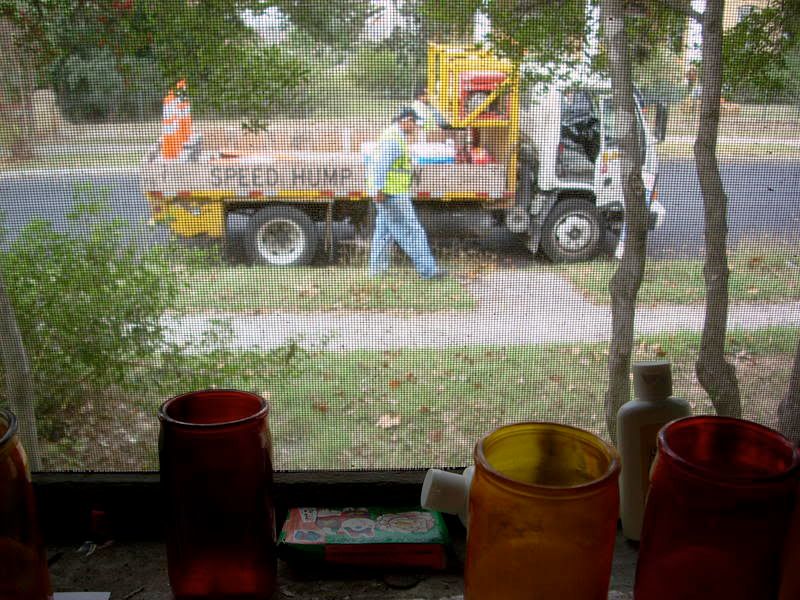
Monday morning I was thinking about crawling out of bed and facing the day. But, really, why? I’d put the trash out on the curb the night before. So I was good there. And then I heard the rumbling of a diesel engine that didn’t sound like the trash crew, and it was just idling in front of my house. So I peered outside. It was a truck with a sign on the side: “Speed Hump Crew.” Great! They were going to start early morning construction in front of my house installing one of those horrible speed bumps. But, wait. All they did was put up a “Work Crew Ahead” sign. They then headed down to the next block to fuck with some other layabout’s sleep. I crawled back in bed. And then I heard my neighbor Jerry shouting across the street to my other neighbor, Bradley. “So, Brad, I see you’re heading into work? You didn’t get the day off?” Suddenly I realized it was a holiday. Fuck! Another goddamn day where I knew my check from that national film organization (who still haven’t paid me) will not arrive. Therefore I had no earthly reason to get out of bed. But I couldn’t manage to drift off, back to sweet oblivion.


I was working on my first cup of coffee and checking out the blogs of a San Antonio artist new to me, Dawn Houser. She had introduced herself to me through MySpace. She’s working in that fascinating growing craft subculture that’s definitely not your mom’s macrame and decoupage. Among the photos of her garden and studio and pets was a wealth of writing. I read some about her recent experience at Stitch, an annual event in Austin that brings together the armies of the DIY handmade expression revolution.

www.dawnhouser.com

And then the phone rang. I was tempted to ignore it, but I took a peek at the display. It was Deborah. And I never ignore Deborah. She wanted to know if I wanted to videotape any of the Dia de los Muertos alters at Centro Cultural Aztlan. This was my last chance. The show was coming down that day. I said I’d be there in thirty minutes. So I took a shower, packed up my camera, and headed out. I detoured down Crofton to bypass the Speed Humpers (which sounds like a particularly lame New Jersey rock band, circa 1989).

Deborah was holding off taking down her own alter at Centro until I got some footage. I made a round through the gallery taking close-up slow passes of about a dozen Dia de los Muertos alters.

Ramon happened to be there. This video taping was connected to a potentially larger project. Ramon Vasquez-y-Sanchez, one of the founders of Centro Cultural Aztlan, had been the first person to think to bring these alters which remember the dead into the realm of the art gallery. Me, Ramon, and Deborah are considering a video project to explore this pivotal point where a cultural phenomenon transitioned into an artistic expression and eventually became the commercial entity it is today.

Deborah asked Ramon is he’d like to sit down for an interview in the gallery and give his history in this development. He said he had to go do something with one of his sons. And then Deborah realized she was supposed to head over to Bihl Haus to babysit the gallery while artists from that gallery’s last group show came by to remove their works. And I had to get ready for a writers group later in the day at Gemini Ink. We decided to get together the next day and have breakfast in La Rancherita’s (where Ramon used to have breakfast every day before work back when Centro was located in Las Palmas Mall). I hadn’t been to La Rancharita’s in two years or so. This was where me and Deborah and Ramon first began to lay down the framework for what eventually became our group identity of Proyecto Locos, resulting in a trip to San Miguel de Allende, a short documentary on that city’s Dia de los Locos festival, and the first annual Dia de los Artista parade and festival here in San Antonio.

We agreed. And we all went our separate ways.

I returned and sat down to read four prose passages by my fellow novel-writers in the ad hock “class” at Gemini Ink. Everyone is supposed to share their first 12 pages with the group, and we all provide one another with feedback.

The first two were well-written but very mediocre. I expect that in two years we will have a computer program that can write stuff like this. The other two pieces both had heart and made me smile. The sort of stuff computers probably will never be able to write (though I might be wrong … I, myself, might be a computer — really, who can tell these days?).

I scribbled out some lame, but supportive comments.

And then I did my best to clean up the first 12 pages of my own November Novel. I’d already posted it on line through my blog. It was a mess. And I’ve cleaned up some of the dumbest typos. The first person to shame me was Thorne. He pointed to a blunder in the very first line. Thanks man, for pointing it out … also for mentioning it in an email and not a blog comment.

I sat down and read through the 12 pages again and found typo after typo. It’s currently fairly clean. Perfect? I doubt it. I’m a horrible speller. And my grasp of grammar is, as you, gentle reader, can heartily agree.

Anyway, I printed up ten copies of my first 12 pages and headed to Gemini Ink. The group is pretty good. My second meeting with them. Some decent insights being shared. And at the end of the night I passed out my pages, and headed on home.

@@@@@

Tuesday morning, at La Rancharita’s, it was the return of the prodigal son. Felix, the owner, ambled over and sat for awhile, commenting on how long it’d been since he last had seen Ramon.

I’d gladly give a plug. A great family-run Mexican cafe on the southern westside. It’s on General McMullen Drive, just a couple blocks north of Castroville Road. Light and fluffy corn tortillas.


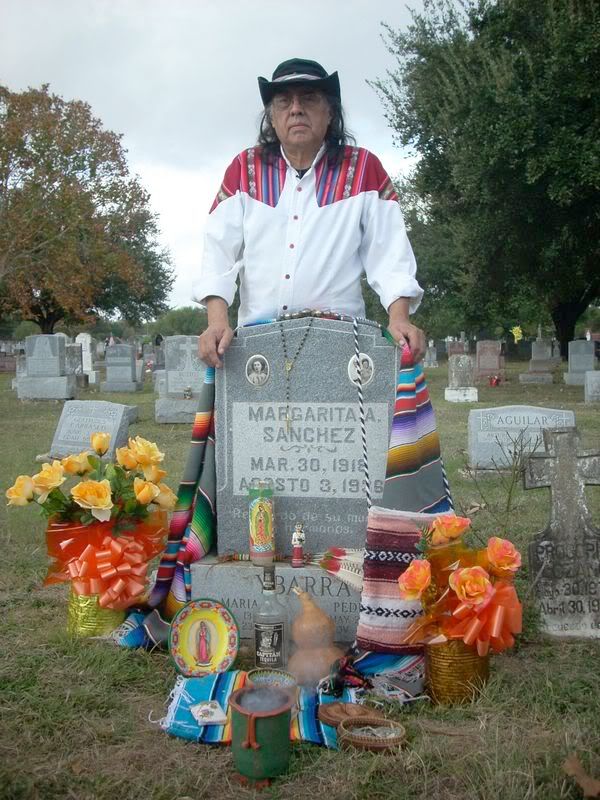
We then headed to San Fernando Cemetery No.2, which is just across Castroville Road from Las Palmas Mall. This is where many of Ramon’s family are buried. We walked to his grandmother’s grave and he set up an alter of things meaningful to her and to him. As a Native American offering, he lit some sage in a clay pot. Deborah attached a wireless microphone to his shirt and I framed in a bit of sky over the gravestone. He gave us a solid oral history of his memories of the day of recuerdos while he was growing up. He then segued into his work bringing the alters into his gallery. And he finished up with a commentary of where things currently stand, with shows all over the country (and abroad) on the second of November.


It turned out very nice.

I grabbed a bike ride later in the afternoon. And I made the mistake of lounging among the fire ants in the grass on a hill overlooking the San Antonio River. It took me a moment to realize I had company, but when I felt the first bite, I sprang to my feet brushing off those evil little bastards. I’m still blaming every poor decision I’ve made during the last two days on the formic acid no doubt still toxifying my blood stream. The pustules are finally beginning to subside.

Oh my god! I’ve the title of my next short film! Finally I feel inspired to make movies again. Tighten your belts, folks. “The Pustules Are Finally Beginning to Subside” will hit the multiplex near you — summer of 2008!

Back home I found — FINALLY — a check awaiting me from a particular national film organization. It only took eight weeks. But good. I was assuming I’d have to live on the bounty of my pecan tree. I was down to “seeds and stems,” as George Cisneros is found of saying, channeling the argot of Richard Linklater’s sophomore film.

I was in a pretty good mood when I arrived at the downtown library for the Film Commission’s final Film Forum of the year. It was all about animation. Folks on the panel from Prime Eights, UIW, Geo Media, New Tek, NESA, and the Film School of San Antonio.

Before the forum began, I was chatting with Michael Druck. When he realized I had seen Bryan Ortiz’s recent short film, Stand, he asked what I thought of it. Well, I know that Bryan and Michael work pretty tightly together, so I tried to be kind. I began by saying I assumed it was done on a schedule crunch, because Bryan usually makes tighter, cleaner short films. My criticism didn’t seem to bother Druck over-much. He was curious of my option. I followed it up with the observation that, had anyone else done this, I’d be fast with the praise. But because Bryan’s work is so smart, clever, and professional, I just wasn’t impressed. He’s set the bar very high for himself. If all anyone had seen of his stuff were these shorts: Compose, Goodbye Digital, and Last Chance, he or she, after watching Stand, would assume that this was the earliest of these four shorts, and not the most recent.

But no disrespect to Bryan. He’s one of our truly gifted emerging filmmakers, and I know I’m not the only one who expects great things from him. And, also, it always good to see Paul Scofield, who is a great underutilized San Antonio actor. So, it’d be a killer film were it directed by, say, Erik Bosse. As a piece given to us by Bryan Ortiz, it’s merely so-so. However, I’ll certainly be waiting for the next one.

And then Janet, from the film commission, came up and requested my “technical expertise.” I explained I had but a modicum. She wasn’t dissuaded. And so I walked up to where the panelists would be seated. I took it that I was to feed the panelists’ DVD demos into the Film Commission’s laptop which was hooked up to the Film Commission’s video projector.

Little did I know, the AV folks with the library had gone home for the day. And there had been no one there to vet the manner in which the equipment was hooked up. Each panelist had a microphone, but the volume, we learned fairly late, was set very very low, and the controls were in a side room behind a placard written in an angry Sharpie: “Do Not Touch Equipment!”

It really was no problem, the hall was small, so the voices carried. And because the turn-out was fairly slight, those who couldn’t hear could move closer. But Drew (our film commissioner) has been providing these film forums as audio pod casts, so we needed to know that everyone had a live microphone. I was thinking it’d all work okay, because the mics were picking up their voices — the output through the speakers to the audience was the problem.

When I tried to play to first DVD of the night, which Angela of the Prime Eights had given me, it just froze up on the computer. And I was trapped, in semi darkness, trying to remember how to operate a PC (me having become a Mac guy). This laptop is what they’re stuck with at the Film Commission. I borrowed a laptop of theirs before. And for those filmmakers out there that think Drew and Janet can wrangle them massive $$$$, I ask that they look at the old equipment they’re having to use. Their resources are always stretched thin, and we need to applaud all the work they do to creatively make their limited funds deliver tangible results — such as these film forums.

And so, I had to shut down the computer. I hoped that by starting it back up, we’d get the disk to play. Nikki (our moderator) thought I’d resolve this issue quickly. She has too much faith in me. But when she realized how long it takes to shut down and restart an old laptop crammed with software, she finally decided to move from making film-related announcements, to talking to the panelists. Fine. Because Angela’s DVD failed the second time. I was ready to blame the computer and not the disk. Angela and Mark had given me a Prime Eights demo disk a couple of weeks back, and it played fine.

I saw that Lee, who was busy taking still photos, had brought his own laptop. But he said it didn’t have the right sort of output for the projector.

And at that moment, Rick Lopez saved my ass. He said his Mac Book Pro (which he had with him) had an s-video port. Konise from NESA hauled out an s-video cable. I quickly conscripted Rick as the AV guy and gave him my chair.

Nikki kept up her conversation with the panelists. But I was having a problem getting the projector to recognize the s-video feed. The guy from UIW (University of the Incarnate Word) quietly handed us one of those Mac VGA monitor adaptors. Rick fed it into his computer and suddenly we had picture.

It takes a village … indeed it does.

Picture, but no sound. Rick aimed one of the spare microphones toward the built-in speaker of his computer. It helped a bit, but not much. I’m thinking it was picked up for the audio pod cast, but the audience had to strain.

Oh well, I think we got the point across.

With the third DVD, Rick’s swank Mac was having problems. And, because the video feed was showing his computer’s desktop, I could see that he had already tried about four different methods to play that particular disk.

I told Rick to cue up the next DVD, and I would try the Film Commission’s laptop on this particular DVD. Maybe it was a Mac issue. It wasn’t. It was a fucked up DVD. I won’t name names, but when the panelist gave it to me, it was the only disk not in some sort of case or protective sleeve. And it was scratched and smudged. From the look if it, I can only assume this individual has been transporting the demo reel inside a mayonnaise and gravel sandwich for quite sometime. It simply would not play.

Luckily, Rick’s computer quickly got aboard the library’s wifi service and we were able to see some of the work being done by this panelist which is posted on the web.

All in all, it wasn’t awful. I was feeling a bit embarrassed that the technical problems, which had been given to me to handle, were only slightly handled. Thankfully Rick was there. But, ultimately, we had some people saying some interesting stuff. And, really, it’s a free forum.

So, as I was helping pack up the equipment — while the rest of the room was getting deep into their networking opportunities — I was somewhat perplexed when Nikki and Janet ambushed me, pleading that I not savage them in my blog.

What?

I was amused by their appeals to my compassion.

Maybe Nikki had recently read the blog entry where I had some snide things to say about the San Antonio Office of Cultural Affairs. She was obviously thinking I had just gone nuts! I told them not to worry.

But I guess the biggest pain in the ass was that I suddenly felt my own performance anxiety. They were expecting that I’d be blogging about the event. IK actually hadn’t planned on it. I mean, I am supposed to be writing a novel. But, guys, here you go.

As we all walked to the library parking-lot, Janet did her best to give us a smiled which failed to mask the obvious tsunami of frustration of a night she thought was an unmitigated disaster. (Janet, it was no such thing.) She wanted to know who was up for a stiff drink.

Later, at Ruta Maya Coffee House (they have a liquor license), I discovered that Janet’s notion of a stiff drink is a single glass of red wine.

And if that’s all it takes to smooth out an unmitigated disaster, you’ve done well.

It was a fun night. I was able to see some great animation work being done in this town I hadn’t even know about.

The only question I have is to Pete. You get any helpful info about rotoscoping?

THE CUCUY CLUB — first draft of chapter one

THE CUCUY CLUB
by Erik Bosse

CHAPTER 1

Jaime jumped out of my truck before I even had time to set the parking brake. We’d spent the last hour on a rutted dirt road and I never managed to get above second gear. A grinning man in his forties — a contemporary of both myself and Jaime — walked out of a large stone building. This must be Carlos, the caretaker of the ruined city of Guerrero. As I walked up, Jaime was shaking Carlos’ hand. I offered mine, and Carlos shook in the manner of la gente, with a soft and gentle touch. Jaime had been in communication with some sort of cultural administrator in this region, and we were expected.

Antigua Guerrero, in the Mexican state of Tamaulipas, lies on the border with the US. Established in 1750, it once boasted a population of 25,000 people. The was before the Falcon Dam was built. But by the 1950s, as the Falcon Reservoir began to fill and swallow up the towns and farms on both sides of the Rio Grande, Guerrero had to be abandoned. And with the great flood of 1954, almost all of the city slipped beneath the waves. Today, the sunken city is only partially submerged. The area now dry is a ruined depopulated colonial city of hundreds of crumbling sandstone block buildings overgrown with cactus, mesquite, and palo verde.

Carlos introduced us to his five lively and devoted dogs. He then took us inside a solidly built cube of sandstone brick with twelve foot high ceilings. It was part museum, part his home. Slipping between Spanish and fractured English, he explained that the local government was working to make the ruined town into a historical park. I gathered he thought we were journalists. And I suppose, in a sense, we were.

There were photos on the walls of the city from the first half of the 20th century. Crowded streets with bustle and commerce. And then Carlos proudly turned to a wooden plank with a rattle snake skin nailed to it. It must have been five feet long.

“He’s a boy,” Carlos said, tapping at a withered piece of reptilian anatomy. I took his word for it.

We followed him back outside. He tossed several items in the back of my truck. A plastic gas tank of diesel fuel, a scorched tin can with a loop of bailing wire through it, and an old single-shot 22 rifle, “for snakes,” he added enthusiastically. We piled into my truck. It was a tight fit. Jaime in the middle and Carlos in the passenger seat, pointing ahead.

As we drove through the ordered grid of stone-paved streets overgrown with spindly weeds, we marveled at the endless flat-roofed stone buildings built from the native sandstone. Carlos’ dogs trotted along in our wake. The buildings were impressive. Fifteen foot structures, mostly, though there were a few with second stories. Some were intact. Others had lost their roofs. Some had even lost the integrity of their walls, and had spilled their great stone blocks, effectively closing off some side streets from any access from vehicles.

“This is fucking amazing,” Jaime said with a big smile.

Carlos flashed us with a grin. Suddenly we were his kind of people.

And from that moment on it was “pinche” this, “pendejo” that, and all conjugations of “chingar.” Jaime had dropped an instant bond on us all.

He has a way of doing that.

Soon we pulled into the old plaza. Carlos pointed to the ground and said something in Spanish I didn’t get. I quickly realized that this is where I was to park — because he was opening the door and stepping out.

I hit the breaks and shut off the engine. Jaime followed Carlos over to the church. It was the only restored building in the whole town. It had a Franciscan-style facade, the exterior had been plastered and painted, and, as I drew near, I could see that the roof had been rebuilt.

The plaza over-looked the waters of the Falcon Reservoir. There was still much of the old city beneath the waves. I walked to the center of the plaza. What had at one time been a fountain was now built to have a circular platform with a little curving staircase leading up. I walked up to look around. The surrounding plaza was just a grassy square with half a dozen stone sidewalks radiating out in measured spokes. I leaned my elbows on the heavy concrete balustrade surrounding the platform.

True to his word, Jaime had dragged me to a weird and wonderful place. His endless quest for the elusive cucuy had us in an extraordinary environment, which was claimed to be haunted. “Though,” Jaime had told me on the drive down, “at the risk of defaming my people, all the places we inhabit are purported to be haunted.”

The plan was to stay overnight and interview the caretaker about the local folklore. It was the tale-end of October and should not get too cold at night. We’d brought along bedrolls, and I supposed we’d just sleep in the bed of my truck, up above the ants and the scorpions.

Carlos and Jaime climbed up to join me. Jaime handed me a can of Modelo cold from the cooler we had picked up in a drive-through shop in Guerrero — the new town of Guerrero. We all cracked open the cans and touched them — “Salud!” — and watched the sun move towards the water of the reservoir.

“I see you’ve found the perfect camp site.” Jaime slapped me on the back. “Up above even the mosquitos. And it’s a full moon tonight!”

We had maybe an hour before sunset. Jaime sat down and began scribbling notes into a composition book with his mechanical pencil. Carlos busied himself building a bonfire out on the edge of the plaza. And I unpacked my digital SLR and hiked around snapping pictures of the ruins. The place possessed a beautiful stillness. A low flung chunk of shadow placed me in cool darkness on a fantastically decayed road with the stone walls of empty buildings pressed close on each side, their foundations bristling with cactus and squat shrubs which had more las espinas than leaves or flowers. In an oak tree at the next intersection a lone cicada pulsed its mechanical song tirelessly as had its kin been doing for millions of years. A swarm of bees were dipping in and out of the white blossoms of a stunted oleander. It’s a non-native ornamental, and must have survived the exodus of gardeners as well as the inundation of the flood waters.

I pushed at a huge warped wooden door and entered one of the homes. The plaster on the walls was white — a bit dusty, but otherwise unblemished. The lone decoration was a photo of Pope Pius XII the size of an LP cover which had been varnished to the wall. All the color of the image had been washed out into various shades of pale blue. Light came in through open double doors that led out to a large walled courtyard. An earthy, ammonia smell made me look to the floor. There was a low mound guano back toward the side wall. I stood still, and then I heard it. A high-pitched clatter like a dozen grocery carts with squeaky wheels. I looked up and saw in the spaces between the wooden roof beams and the plaster ceiling maybe 25 Mexican freetail bats roosting, awaiting the setting sun. That reminded me that I should get back and begin unloading our meager camp gear while we could still see what we were doing.

By the time I reached the plaza, it was deep into twilight. I saw that Jaime had already rolled out the sleeping bags up on the platform above the defunct fountain. He pulled the cooler over to where Carlos was dousing the bonfire with the diesel fuel. I could see from the empties that the two of them had been busy hitting the vast stores of Modelo we had transported in. I had some catching up to do. As I fished a beer from the cooler, Carlos walked up to me. He handed me the scorched tin can and motioned me to follow. He was lugging the can of desiel. We walked to the lone tree in the plaza — a dead skeleton — which was halfway between the bonfire pit and the central fountain.

At the tree Carlos put down the diesel. He took the can from my hands and filled it about a quarter full with dirt. He handed it back to me. I took it and watched as he picked up a thick flat chunk of the local sandstone. He raised it over his heads and threw it down onto the one of the paved paths of the plaza. It shattered into half a dozen pieces. He took hold of the largest, about the size of a plum. He put it into the tin can I was holding. With the dirt beneath, it poked up above the rim. Carlos told me, in English, to keep still. He opened the desiel can and lifted it up and poured the stuff over the rock and into the can. Maybe about half a cup of diesel. Carlos pointed to the can I held and he pointed to the tree. He said a word in Spanish I didn’t recognize. But I understood. Using the baling wire attached to the can, I walked over and hung it from a branch on the tree.

Over at the bonfire I heard Jaime open a beer. And then he shouted something about was it really up to him to get this fucking party started? And he tossed a match into the stack of diesel-soaked branches. At that point it was almost full-bore night. The violent rise of flames was wonderfully spectacular. A white-tailed deer, startled from her hide-away too near the bonfire, bolted, running across the plaza. Her shadow, cast by the fire, proceeded her for the entire gallop, and when she rounded to the safety hidden behind the church, everything suddenly became ominously silent. Until, two beats later, the buoyant laughter of three drunken pyromaniacs warmed the night. And then Carlos lit a match and touched it to the tip of the sandstone plum in the soup can hanging from the tree. It flashed alive with a jittery tongue of flame playing up, quite bright.

Carlos called it a Mexican candle. I asked how long does it last. He shrugged, and said he guessed three hours. Something he learned, he said, in the army.

We had brought along a couple of folding camp chairs. I took my seat on the stout plastic cooler. And the three of us roasted hot dogs on green mesquite branches, and we placed them in flour tortillas and smeared them with ketchup.

Carlos told us that he’d been the caretaker of this amazing ghost town for two years. He said that there was a treasure hidden under the property of the ruins of the old hotel, and this was obvious because of the flickering blue lights you could often see over the ruins at night. He explained that when you saw a rattlesnake you whipped off your hat and you tossed it on the creature. He went ahead and did this for us as an example with his baseball cap. The idea was that the snake would strike at the hat, thereby discharging all its venom. At that point you could safely kill the snake. Carlos retrieved the hat and let us examine it for all the holes from previous snake deployments. I confess I could discern nothing resembling fang marks. He made a few comments about the little anglo boy who haunted the church. And then he pointed out three stars in the heavens. They point to the north, he told us, and when you learn these stars, you can never get lost on a clear night.

I understand we’d been drinking, and Carlos more than I, but I was pretty certain that there is no way that one can use the three stars that comprise Orion’s belt to navigate to the north.

Jaime seemed to find all this talk delightful. But eventually he gave me a nod. I pulled out my video camera. As Carlos and Jaime each fished beers from the cooler I was no longer sitting on, I set up my tripod and then attached the camera on to it. I have a small but powerful LED light that perches atop my camera, drawing power from a battery belt which I slung over the tripod arm. I framed Carlos so that the bonfire was just over his left shoulder. I moved Jaime’s chair around so that the camera would get a bit of his shoulder in frame, slightly lit by the Mexican candle. I clipped a wireless lavaliere onto the lapel of Carlos’ denim jacket.

When I hit record, I nodded to Jaime. He began the interview process, seemingly suddenly sober … sort of. The two of them were speaking exclusively in Spanish. And I know I should damn well learn the language. Hell, I live in Texas, where the language is increasingly dominate. But as they moved deeper into the information we’d come to collect — the ghost stories, the weird folktales — I began to tune it out and turn to the beer in the cooler. Actually, I was waiting for the moon to come up. It wasn’t truly a full moon. A bit late for that. But when it pushed up over the horizon (washing out that beautiful swath of the Milky Way), I was so beguiled by the beauty of the night here in this forgotten place, that I gave up on even the pretext of trying to follow the interview. The audio feed was strong, and the video frame was wide. I was tempted to walk away and tour the ruins in the light from the moon. But before I could fully contextualize my place in this project, I saw Jaime stand, brush back his hair and offer Carlos his hand.

Carlos shook both our hands. And he walked away into the night with his dogs. I had no doubt he could find his way back. Jaime nodded to me with a serious air. In his book, it had all gone fine. I watched him walk to the center of the plaza and climb to the raised platform. It was bedtime. I dismantled and packed away the camcorder, tripod, and audio equipment.

@@@@@

I caught up with Jaime a couple of nights later at the Cucuy Club. It’s his hangout, no more than a leisurely walk from his apartment. The place is an ice house on Roosevelt where you can buy beer to go, or, as do most of the habitués, grab one of the mismatched chairs and enjoy a cold one while watching the traffic go by. The Cucuy Club is run by a corpulent woman named Norma who rarely talks but is always quick to respond to her longwinded beery clientele with a deep laugh sure to display her few remaining teeth. At least three nights a week one of her sons would cook up a mess of barbacoa or tripas in the firepit out through the back door.
Jaime sat bent over at one of the picnic tables, his face aglow from the screen of his laptop. I took a seat across from him, and he didn’t look up until Norma sat a Lone Star tallboy in front of me and cracked the top. She gave me a little cursory hug and ambled off to sit with her gaggle of regulars who held court in a line of rusty folding chairs that faced the Whataburger across the street.

“See what you think,” Jaime said, turning the computer around so I could read what was on the screen. And he headed off, I presume to see what Norma’s boy might be cooking up.

The essay was titled, “El Niño de Antigua Guerrero Viejo.”

This would be going into Jaime’s blog, also called The Cucuy Club. It’s his current obsession, which he’s been working on for almost two years now. He’s been chronicling the folktales of San Antonio and south Texas. The ghost stories, the cucuys.

@@@@@

El Niño de Antigua Guerrero Viejo

This isn’t the first variant of La Llorona mentioned in this blog, and it certainly won’t be the last. It’s one of the top five creepy folktales from my boyhood. If you were to take the downward pointing isosceles confined by Zarzamora, Nogalitos, and Guadalupe Streets, you would be hard pressed to find a family that does not have their own twist on this Latina Medea tragedy. And whether the roots extend all the way back to La Malinche or just a generation back to the sister of the neighbor of your great uncle Silverio, the legend is used the same by parents all over: “Shss, children. Did you hear that? It sounded like La Llorona. You’d better be quiet. She might hear you and take you away with her.”

Last week I decided to go further afield then I normally do in search of these cucuys. A friend had alerted me to an incident that happened not so long ago where a little boy had died because of the influence of La Llorona. And so I decided to take to the road, as a rather aggressive collection agency was wearing me ragged. So, I with my lap top, and my research assistant, Rico, armed with his video camera, headed down to the Rio Grande Valley.

At the river road, we headed north, just passed the town of Roma. And we crossed over into Mexico across the dam of the Falcon Reservoir. The Mexican town of Nueva Ciudad Guerrero was a powerful indication we were on the right trail. We were in search of the ruins of the old city of Guerrero — Antigua Guerrero. When the dam was built back in the 1950s, that city was sacrificed, and much of the citizens and commerce was relocated downriver where the dam spanned the two countries.

It took us two hours in Rico’s truck from the new Guerrero to the old Guerrero. Most of the time was over a rutted dirt road through desolate ranch land where we never saw another human being, and only, at most, five cows.

Finally, we arrived. The caretaker of the place instructed us on where we could set up camp. The original church, in the heart of a maze of ruined buildings, was the only structure which had been restored. We settled down there, and as the sun set we enjoyed a little a barbecue, and then Rico wired our host up for sound and rolled camera.

We were told the story of El Niño de Antigua Guerrero.

First he gave us the old town’s particular take on La Llorona. She was a poor girl named Marta who lived “long ago.” And when a rich rancher from Durango who was in town buying cattle began to lavish attention on the girl, her father, a baker, was overjoyed. The couple were soon married. They lived in a large house in the middle of town. And throughout the spring, the rancher visited all the farms in the area buying the best cattle. Finally, he hired some men from town to help him drive the cattle back to his hacienda far to the south, explaining to Marta that he would send for her.

Weeks passed and finally the men the rancher hired for the cattle drive returned. They told of the enormous wealth and huge holdings of the rancher’s hacienda. They also mentioned his wife, a beautiful and grand woman reported to be connected to the Spanish aristocracy.

Marta refused to believe these rumors. But as she waited, she never heard from her husband. It soon became apparent she was pregnant. The landlord of the large house the rancher had rented eventually had to ask her to leave when the rent money ran out. Marta’s father could not refuse to take her back in, but the family clearly felt the weight of shame. When Marta gave birth to twins, the local priest declined to baptize the children until he could confer with the Bishop. Despondent, Marta drowned the children in the river. She returned to her father’s house without her children. The town was scandalized. She was asked over and over where they were, and finally, three days later, she took her own life.

The story takes a bit of license when we find her ascended to heaven. God asks her where the children are. She still refuses to answer. He banishes her soul back to Earth, instructing her to gather up her children before she can return to Heaven.

And so her ghost roams the river, calling for her children; and actually, any children’s bodies will do, so she’s also trying to coax living kids into the waters.

And that is a fairly typical La Llorona telling, made so wonderfully authentic in that we were gathered around a campfire. Well, most of it was lost on Rico, as he doesn’t really understand Spanish.

And then our host launched into the historic part of the tale.

Back in the mid ’50s, most of the city was under water, including the church — only the curved vault of the roof poked up, as if gasping for air. And for the next couple of years the waters subsided. There was a time, before the church completely emerged. A motor boat of rich Americans on a fishing holiday came into the drowned town. They were two brothers from Houston, and one of them had his little boy. Just the three of them. They tied the boat to the side of the church and climbed up to the roof. Half of the roof had collapsed and they looked down and saw a school of catfish lazily nosing through the muck around the sunken alter.

They assembled their fishing poles and dropped their lines into the waters inside the church. They were very successful and spent two days on top of the church. On the second night, the father of the little boy awoke because he heard a woman crying loud and sorrowfully. Suddenly he heard what sounded like a boulder dropped into the waters of the church. Then, silence. The woman cried no more. The bedroll next to him was empty. His son. They found the boy at first light floating above the alter.

And when the waters finally pulled back for good, the ghost stories began. People would hear a little boy weeping. And when they saw his spirit, the little anglo boy was barefoot in jeans and no shirt. No one ever heard La Llorona crying in anguish in that region. Just the little boy.

Our host, when asked if he had ever seen the boy, answered without hesitation. Of course. And all the workers, throughout the years, who had been involved in the reconstruction of the church, they, too, had their stories to tell.

I went to bed that night sleeping beneath the stars on the old plaza, and I wondered how I would go about trying to verify the name of the little boy. If, indeed, he existed. But isn’t the story enough? Sometimes I wonder.
I should add here that at 2:37 (I know this, because I looked at the time on my cell phone), I awoke because of some sound. Remembering the story of the boy, I strained for the sound of crying. But it was this great rush of a massive wind. But that couldn’t be. I looked to the trees on the edges of the plaza. They were all brightly lit by the moon, and they were motionless. The sound of wind was at hurricane force, but I felt nothing on my face. I turned to peer at the church, solid and silver under the moonlight, and I noticed a flickering blue light issuing from the opened doors and the upper windows of the front facade. It was like there was some powerful chemical fire in there with that beautiful unnatural light one expects from the dials of a car stereo. And, like a light switch turned off, the sound vanished. The blue light flickered low, it flickered lower, and it was gone. Nothing. Just the soft snoring of Rico, bundled in his bedroll beside me. I waited, watching and listening intently, and eventually, I guess, I fell back asleep.

@@@@@

“Rico” would be me. That’s how I appear in all of the blog entries. I don’t know why. And, thankfully, Jaime never calls me by that nickname.

I looked up and realized that Jaime had placed a plate of carnitas in front of me. There were four store bought corn tortillas draped over the meat. I could tell they had been heated over hot coals. I blew the ash off the one on the top and I made myself a taco. Jaime pushed a plate of chopped onions, cilantro, and limes cut in half across the table.

“Well?” he asked, pulling his laptop back to his side of the table.

“It’s good. But, um, did you really hear all that shit?”

“Artistic license. Wouldn’t you?”

“Good. ‘Cause I know I don’t snore.”

“Okay,” he said with a smile.

One of the reasons Jaime frequented the Cucuy Club was because he was able to clandestinely highjack the wifi signal belonging Marco Ruiz, a wildly successful local chicano artist who enjoyed slumming in his southside apartment on the second floor of the pool hall just across the railroad tracks from the Cucuy Club. “You know, he sends his kid to a private school,” Jaime will often grumble, thus justifying his wireless poachery.

I watched as he opened a browser window on the computer, uploaded the text to his blog, and then, with a flourish, he clicked on the “publish” button.
Chapter 1 of The Cucuy Club

For those curious about my november novel (AKA, “The Cucuy Club”), you can click over to my fiction site and read a very rough draft of chapter 1.

http://erikbosse.wordpress.com/

Much of the description of the ruins of Antigua Guerrero were inspired from my recent trip to Mexico.

Hope you enjoy it.

SAFARTS — Thanks Felix & Ernest!

For those half-dozen loyal blog readers, I’m sure my absence has been chalked up to the fact that I’ve been slaving away on my November Novel (because, least we forget, November is national-novel-writing-month). I only wish that were true. Well, it is, to some degree. I’ve been moving along fairly well, but I have to admit I’ve fallen behind a bit in my word count.

The truth is I’m always on the lookout for an excuse to put off … well, anything.

Like last night. I had a dinner meeting with AJ Garces. We were supposed to meet at a particular Jims restaurant, but it was packed. We relocated to a nearby Dennys. AJ noticed that Dennys was using some of his clip art (Havana Street dot com). And so we talked about a couple of different projects we were working on. Nothing too extreme. Yet we didn’t get out of there until midnight. Now, sure, I could have explained that “I need to get home and work on my novel.” I did not. And there went my Thursday night.

Or how about tonight. It’s now seven thirty. I was over at Urban-15 earlier this afternoon talking to Catherine Cisneros. She and her husband George have enough faith in me that they’re bringing me onboard to write grants. Although, because George had to head up to the north-side, and because their groundskeeper and their building manager eventually left, I hung out to keep Catherine company, even after we’d wrapped up business. Because, well, you know, the place is haunted, and I’d be remise to leave her alone with the unsettled spirits. (Even I, an agnostic in such matters, had heard at least one of the ghosts be a pest.) She suggested I microwave some rice and fish left over from lunch and we had a bottle of white wine as we trash-talked some about the local luminaries whose acquaintanceships we had in common. She eventually received a phone call from George. He decided he had no reason to return to the building, so we could lock up and leave. So we did.

And now, back home, I have no reason not to add more pages to my novel. Except … hmm, wait! It’s been a spell since I’ve added to that ol’ blog. And I believe I have at least a photo to upload.

@@@@@

If those bastards who run a particular national film organization would just pay me the damn money for the work I did for them seven weeks ago, I wouldn’t be begging rice and fish. But on a bright side, I picked up a useful tip from my sister’s blog. Boil pecans for five minutes and they are easier to shell. I don’t know if you could get the same effect by soaking them in room temperature water (I’ll do that experiment when CPS turns off my gas because of lack of payment — you know, because of those bastards with that national film organization who are so slow to pay). But back to pecans. This does work. Boiled, they peel real well. And because the mammoth pecan tree above my driveway has unleashed chingas (if I might be excused use of the local patois) of nutty goodness, I’ve been able to add free food to my meals. It seems I’m well on my way to embracing the hunter and gatherer lifestyle. The latter is a snap, and the former seems a clear enough path — I’ve already formed a palpable dislike for the Alsatian over the back fence who shoots me a baleful glare as I hang my laundry. I’ve begun to appraise those meaty haunches with a culinary calculation.

@@@@@

Day before last — Wednesday — I made sure to keep my calendar open (don’t smirk). San Antonio’s Office of Cultural Affairs (OCA) was having their annual Creating Ways conference. It was free. All I had to do was sign up via their website (which doesn’t seem to support any browser but Internet Explorer — people still use that?). I didn’t have much of an idea what to expect, but it was downtown (a five minute trolly ride away), and I was promised a free box lunch. Also, I knew about six people who were also going. Count me in.

I got there a bit after eight in the morning. Great coffee. Fruit and croissants. I talked some with Rogelio, a fellow filmmaker who I hadn’t seen in months. And then I went and spoke with my friend Deborah who was standing with some of the docents from Bihl Haus Arts. I then realized they had a table set up there in the lobby. Kellen and the docents were setting up piles of literature.

Just before the doors to the conference opened at nine, I saw Catherine Cisneros (of Urban-15) and Malena Gonzalalez-Cid (of Centro Cultural Aztlan). They invited me to their table. I followed them inside. Denise Cadena (also of the Centro) was there as well.

We began with the basic opening comments from gassy bureaucrats. Eventually Felix Padrone, the director of OCA, stepped up and gave a nice over-view of what his office is currently engaged in. OCA is connected to several really great programs to help both individual artists as well as artistic organizations. Sadly, Pete Barnstrom couldn’t make it. He had just returned from a film festival in Costa Rica, and, one can only imagine, was busy weaning his young’un off the week’s worth of pure cane sugar and caffeine made available by an indulgent baby-sitting grandmother. But Felix made mention of “enjoying those amusing emails from Pete Barnstrom,” and then there was a quote from Pete (concerning, I believe, the Creative Capital conference, funded by OCA) which was projected on screen during one of the Power Point presentations.

Who still uses Power Point?

There were 400 artists in attendance. Can there be a format more aesthetically bereft than Power Point? No, I think not. And some of these drones were giving us texts on randomly chosen color schemes such as lime text on magenta background. This sounds comical, I understand. But take a moment to consider this. Artists are trained in this sort of graphic layout approach, with color and proportion and et al. And these assholes with the city seem not to have considered it worthwhile to hire an artist to design their presentations. Tax dollars are going to fund this, the Office of Cultural Affairs, and there seems to be no one with a modicum of art training on hand to interface with the public, or worse, to interface with the art community.

And then we got what, I assume, the whole performance was all about. The unveiling of a new ad campaign. The ad group is PR titans, Bromley Communications. They trotted out some tissue of crap meant to distill the San Antonio art scene. They were gonna brand us! While their ill-conceived ad campaign played itself out on the two big video screens on each side of the podium, we were also treated to images from the website … a website designed by G2E Services. There can be only one reaction. Dump Bromley, and give the entire contract to G2E. Do it today.

What this Bromely chap told us, with a chuckle in his voice, that his firm had looked into the demographic they wanted to pull into the arts. “She’s a woman,” he began, “between the ages of 18 and 48. Married with children.” I guess he assumed she was the culprit. You know, that person who wasn’t patronizing the arts enough. “We call her Minnie Van Norma.” Or was that “Mini Van Norma?” It took me until the third time he said that line to figure out this play on words. You see, this Bromely dude was labeling soccer moms. I’d like to know where is the line-item of the budget they’ve tended to the city which breaks down the amount they think this phrase is worth — ’cause it strikes me as an in-house bit of rhetoric that no self-respecting ad firm would ever allow to get out into general circulation; and there they were, spouting it out for 400 artists to hear. That’s strike one against them.

Now, as someone who was brought up as a good all-American feminist, I was rather offended. And during one of the breaks, I did my own straw poll. I found no one who thought it clever. Two people smiled indulgently as I sputtered my own disbelief. Four individuals agreed with me. And six people, all women, and all heads of arts organizations in town, were even more disturbed than myself.

Beyond Minnie Van Norma, they showed us their logo. “SA[heart shape]ARTS.” And then they expanded it to slogans such as SAHEARTS. One of the folks at my table scribbled on a napkin, and passed it around our group. SA[heart shape]ARTS — a letter “F” had been placed inside the heart shape. SAFARTS. I whipped off the pen I carry clipped to my collar and added some radiating lines coming from the rounded cleft top of the heart, representing the gassy and farty nonsense emanating from this conference. A couple of folks at an adjacent table, spying this whole new exciting logo, smiled and nodded encouragement my way.

SAFARTS it is.

But don’t think I wasn’t impressed and entertained and informed. I mean, shit, the coffee was good, I enjoyed my free box lunch, I met some good friends, and, best of all, I was absolutely blown away by the guest speaker, Sir Ken Robinson. He’s featured on the TED talks website. He’s one of the great public speakers and one of the great minds of our age. It was an amazing privilege to spend over an hour in his presence.

Also, I bumped into Mark Walley and Angela Guerra. They make video and graphic art under the guise of the Prime Eights, but all I’ve been able to see so far has been their website (brilliant!). Their video is compressed and provided in some manner in which my computer, operating system, internet browser (or some combination) won’t allow me to access. When I mentioned this, Angela reached into her shoulder bag and handed me a DVD of their reel with killer cover art. Maybe I should watch it right now. But do I dare? Aren’t I supposed to be writing a novel?

@@@@@

When I blogged about what a blast it was wandering the ruins of the drowned city of Antigua Guerrero, I made a point to explain that the gothic factor of this ultra cool experience was sure to outstrip what my friends would be doing in the days to come with Halloween and Dia de los Muertos.

For those readers out of state, Dia de los Muertos is a celebration of those loved ones and family members who have passed on. It’s celebrated on November 2nd. There are plenty of internet resources to enlighten. But here in San Antonio, there is a more specific component (which has moved out to many other cities). And that is bringing these Dia de los Muetros alters into the galleries. Ramon Vasquez y Sanchez, a man whom I’m privileged to call my friend, brought these alters into the local galleries as an expression of Chicano art way back in the ’70s. And this practice has become ubiquitous in the San Antonio art scene, and it’s moving out into the society in general.

And so I made sure to attend the show at the Centro Cultural Aztlan before considering all the other choices offered in the art galleries throughout San Antonio on the night of November 2nd (which happened to fall on a Friday, a night of gallery openings, but this was also First Friday, when the galleries in the artsy neighborhood I call home would be making significant noises). Ramon had his own artist alter across town at the McNay Art Museum. But Ramon is one of the founders of the Centro Cultural Aztlan (though he’s recently retired), and as the chief of the local Indian tribe (a part of the Coahuiltecan nation), Ramon was on hand to provided the blessing. He was in his indigenous garb, holding a stone with sage and other herbs burning — he wafted the smoke our way with an eagle feather. He’s a very articulate and moving speaker. It was a wonderful evening.

Photobucket - Video and Image Hosting

Deborah and the docents from the Bihl Haus Arts Center invited me to dinner. We went to Jacals, a nearby Mexican restaurant Pete and Lisa turned me on to when I first visited them here in San Antonio. The Bihl Haus docents are all elderly women. The gallery is in an ancient refurbished house which has been surrounded by a retirement community (the Prime Rose), and as such, the residents help run the place. There were 12 of us at the table. And not only was I the only man there, I was also the youngest. And as the Margaritas began to flow, I had the head docent leered over to me and ask how it felt to be surrounded by my own harem of Golden Girls.

I muttered something noncommittal (probably about the weather) as I scarfed down my guacamole chalupa.

@@@@@

Okay. I really do have to head off and write a novel. Or, um, go to bed….

La Marchanta — Days Two & Three

I’m going to make a quickie cursory entry about days two and three on Anne Wallace’s Marchanta project.

The fact is, I’m in the midst of November — you know, national novel writing month. And so, much of my free time is being taken up by working on my novel. Or so I tell myself.

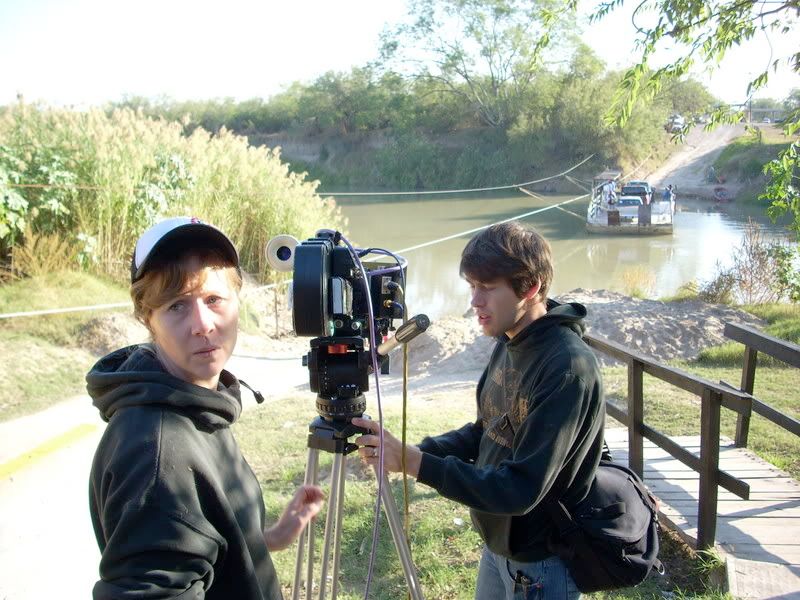
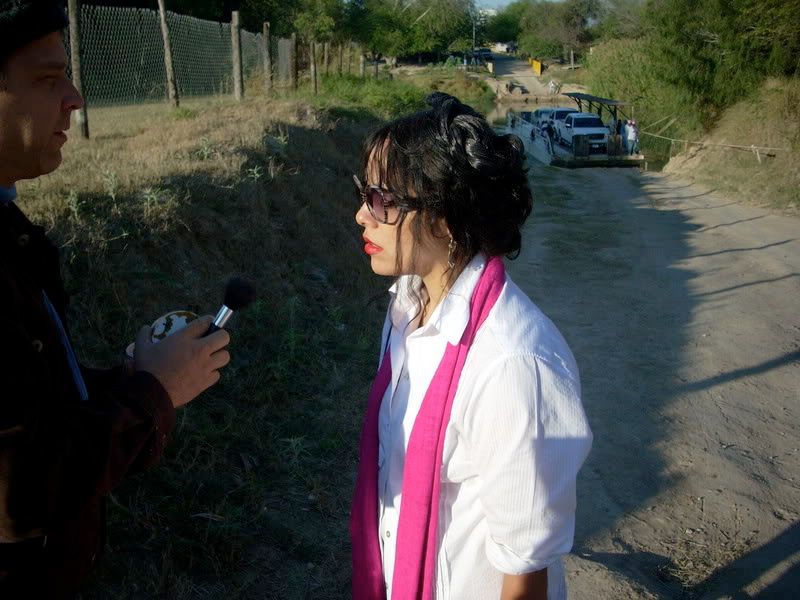
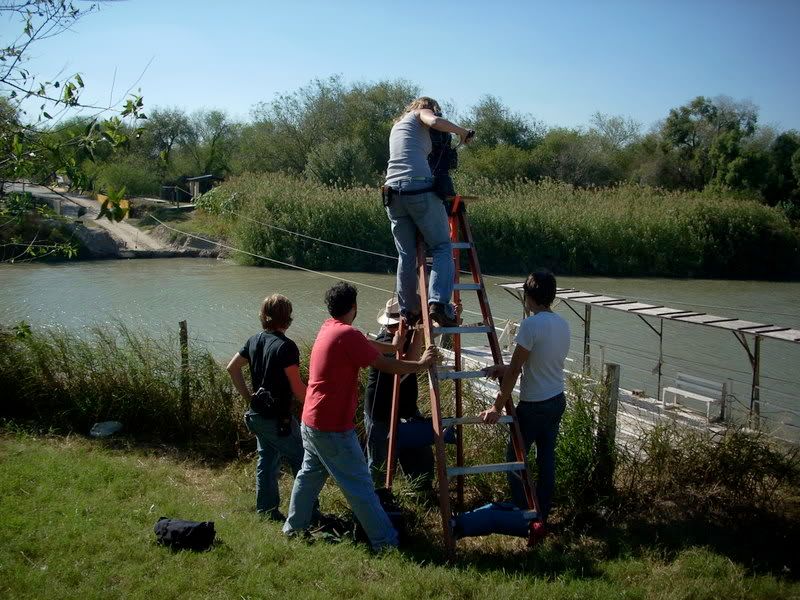
The second day of Anne’s shoot was back to the ferry. We shot on the American side, Mexican side, and then on the ferry itself, traveling between the two nations. Sadly, however, we were kicked out of Mexico when the Mexican customs official ambled up and politely told us we didn’t have clearance. Anne had assumed we were cleared. But somewhere, among all the convoluted bureaucratic entities, she’s forgotten one. But it was okay. We’d already gotten plenty of footage.

Back on the US side we set up a few more shots. And then we all piled into our vehicles and caravanned into Mexico. We crossed over by driving across the Falcon Dam. Very spectacular. Anne had a Mexican official meet us at the other side to expedite our entrance into Mexico. We were 12 individuals in five vehicles transporting about fifty thousand dollars worth of camera and sound equipment.

After getting the okay, we took a moment at a Pemex station for one of the cars to gas up. Many of us took advantage of the adjacent drive-thru beer store. This was the town of Guerrero, or, more to the point, Nuevo Guerrero.

And then we headed to the highway and drove upriver. We were driving to the town listed on the map as Guerrero Viejo. AKA, Antigua Guerrero. The ancient town of old Guerrero is my half-ass translation. I knew nothing about the place, except what Anne had told me. Something about a town that had been submerged by Falcon Reservoir.

We drove maybe 25 miles on the highway before turning off onto a rutted dirt road. We were a pickup truck (me and Carlos), two robust SUVs, and two little cars. The cars slowed us down somewhat. But the hour we spent on the unpaved road wouldn’t have been that much shorter without the cars. It was rough going.

I would like to have the time to describe the extraordinary ruins of Guerrero Viejo, but, again, I have a novel I need to be working on. Actually, I decided to use my experience in this wonderful town as the opening chapter of my November novel. And I’ll post those pages eventually.

To put it into a thumbnail, we had the ruins to ourselves. There were scenes involving galloping horses, underwater videography, audio recording of bats, and cameras mounted in a canoe.

I had a blast. One of the best memories was when me and Carlos (Carlos Pina — filmmaker and actor — not to be confused with the other Carlos, the caretaker of Guerrero Viejo) decided to wander the ruins of the city in the bright light of a gibbous moon when everyone else had gone to sleep. It was so damn cool. And I knew that this would blow away all the bullshit my friends would experience in their impending Halloween AND Dia de los Muertos party plans. Fuck, I was poking around the dead and haunted ruined city of Guerrero Viejo, in the state of Tamaulipas, in Mexico.

Maybe when I get this novel shit out of the way, I’ll blog more about the experience. It was really wonderful.

Below are a bunch of photos from the trip.

Click on the tumbnails for bigger images.


La Marchanta — Day One

It’s Halloween night. The kids were out in force on my block. Personally, I kept the lights off. However, I did wander over to Jerry and Becky’s place to watch the festivities from their porch. Jerry has managed to rig a pulley system from his porch to the Toland’s house across the street. Folks on each porch took turns pulling a suspended ghost from one side of the street to the other in attempts to scare the trick-or-treaters. Amusement in lieu of fear is also allowed during this celebrated night. The Cortez’s have their house decked out in spider webs and caution tape and etc. Our street has a very festive air.

Photobucket - Video and Image Hosting

Midnight will usher in November — AKA Novel-Writing month. Only two hours away.

@@@@@

I arrived back in town this morning at 5:30 after three days shooting with artist Anne Wallace on her project entitle La Marchanta. I hit the sheets, exhausted, a bit before seven this morning and slept through till two in the afternoon.

Back on Sunday morning I met the group at Anne’s place. She lives about six blocks from me in a lovely, funky clapboard home. Monessa Esquivel answered the door. Up to then I wasn’t sure if she really knew who I was, but she smiled and greeted me by name and invited me inside. She was trying on some of the costumes her character would be sporting. Anne came into the room and I was finally able to put a face to the voice — I’d only communicated previously on phone and email. She escorted me into the kitchen and fixed me a cup of cafe con leche. Soon Rick Frederick and Ethel Shipton entered, as good friends do, unannounced and through the back door. Rick was officially listed as Assistant Director. But he was as new to production as Anne, our Director. Neither were completely sure what their roles entailed. (Actually, I should point out that Rick, recently relocated to San Antonio from the midwest (Chicago? Detroit?), is an actor and no stranger to a film set, at least in that capacity. Ethel was to be our still photographer. But, as the three days unfolded, they both would prove to be the hardest working and most crucial members of the crew.

There had been some hold up with the camera folks coming down from Austin. But they finally showed. They all seemed to know one another — most had met while taking film classes as undergraduates at UT. They were kids — at least relative to us of the San Antonio contingent (with exception of the youthful and glamorous Monessa).

Ellie Ann Fenton was our DP. She’d rented or otherwise acquired an Aaton super 16 camera. We also had Mike Simpson, first assistant camera. Homer Leal, second assistant camera (who would meet up with us at our first location). Jesse Haas, streadicam operator (he would also be doing the underwater video footage). Marco Pena, gaffer. Robert Garza, second unit (he’d be shooting video elements that Anne wanted incorporated in with the film footage). We’d also be meeting up with Carlos Pina when we reached our first location. And with me, running audio, it took us to 12.

When all the Austinites arrived, we repacked the cars, and soon we were ready to head out. Five vehicles. Luckily I had my truck. We were hauling so much crap, I don’t know how we’d of done it without. Next stop, the Rio Grande Valley.

I drove down with Marco. We managed to meet up with Carlos at an HEB on highway 83. Cell phones have changed the world of film production. I explained where we were headed to, and as a valley boy who knew the area, Carlos took the lead. We followed him back on to the highway. After only a quarter of a mile, Marco said: “There’s Jesse.” And it wasn’t just Jesse’ Jeep, it was Ethel’s SUV, Ellie’s car, and Rick’s car. And I thought we weren’t caravanning. But I guess everyone else was. Carlos, in his van, me and Marcos in my truck, eased into the convoy’s wake and followed them out to Sullivan City, and took a left, toward the river, toward Mexico.

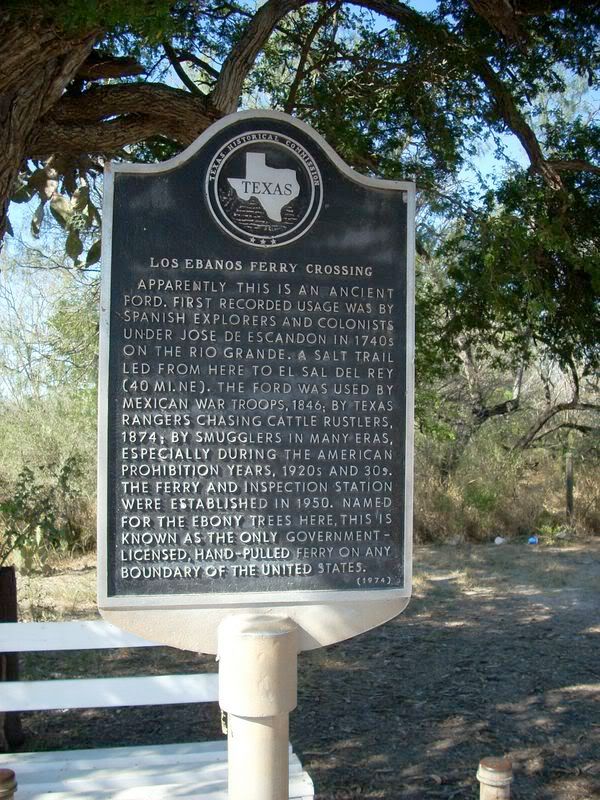
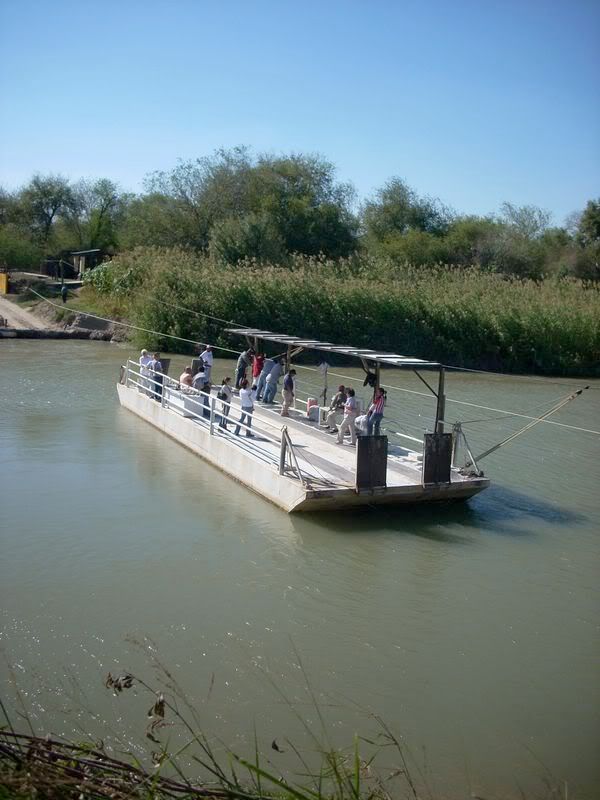
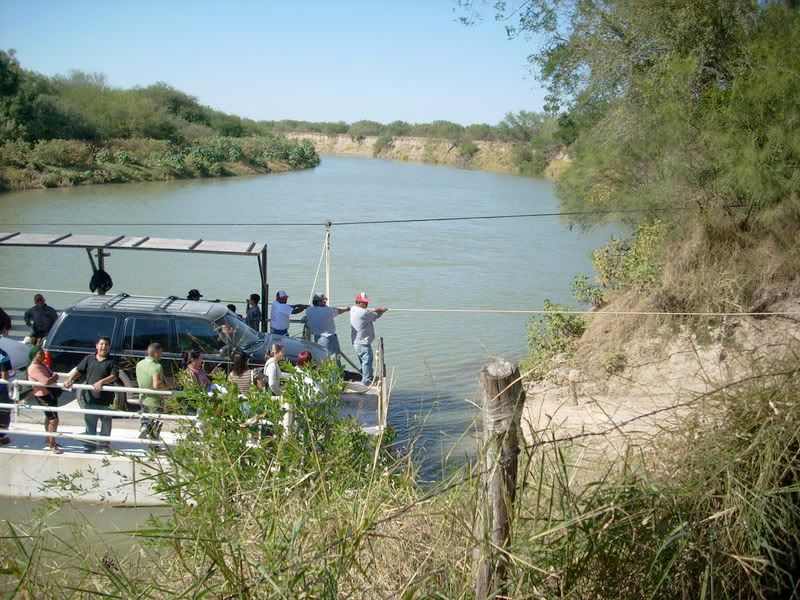
All of us pulled into an unpaved parkinglot. This was the Ebanos Ferry. The ferry holds three cars and, I suppose, as many people as can stand on it. It’s positioned at a bit of an angle on the river, so that when it crosses to Mexico, the current pulls it across (the boat is attached by pulleys to a cable that runs from one country to the other). But on the return trip, they have four men pulling the ferry back across.

Anne had cleared things with Homeland Security. And she went to their kiosk to see if things were okay. Things are never 100 percent okay when men wearing uniforms are involved. But she cleared things up with a single phone call. The guy who owns and operates the crossing was another matter. He was wonderful and accommodating.


Our biggest concern was time. The ferry only ran until mid afternoon. And we had made our start out of San Antonio late. We put ourselves into gear, and tried our best. But every new production is on a fresh learning curve. You’re never getting to optimal interactivity as a group until at least the third day. So, as the camera crew were setting up equipment, we had to just stand back and let them do their thing.


There was a point when a key got locked in a car. I’ll refrain from saying who did what, but I took a photo of Monessa trying to gain access to the car with the only piece of wire available … unwoven from a barbed wire fence.

I made a comment to Ethel about Monessa’s character from “As Filthy as it Gets” (a two-woman show written and performed by Monessa and Annelle Spector where they transform into the self-destructive rockers May Joon & Ann Jewlie, AKA, the Methane Sisters). I said she’d never be stymied by such a problems. She’d either just pick up a rock, or —

Ethel held up her hand.

“Or she’d rip out the underwire from her bra –”

“And,” I said diving in, “in one fluid motion she’d bend a hook on one end and slip the wire through the top of the window and whip it back out. Snap, Unlocked! And she’d lean in and root around the backseat, screaming that some asshole had got in and stole her fucking Jägermeister! At which point Ann Jewlie would walk up and ask wasn’t her car red? May Joon would then stand up, nod solemnly — the mistake seeping in — and she’d stuff into her pockets the pack of cigarettes and the pair of sunglasses she’d lifted from the car, and then she’d slam the door with her hip.”

@@@@@

We’d met up with Homer at the Ferry. But we only had a short period to shoot there, so by later afternoon we wrapped and caravanned to Roma where our motel was located. We’d be back the next day to shoot more at the crossing.

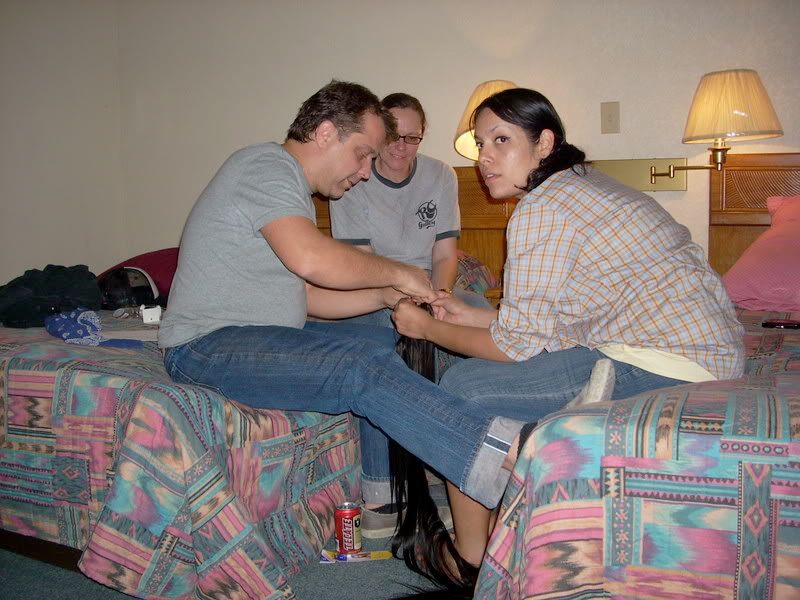
Anne checked in for all of us at the motel. Four rooms with two big beds apiece. The rest of us began unloading the vehicles and putting the more precious items inside. We decided to go get dinner. But because we were in a small American border town on a Sunday night, we of course decided to grab a bite in Mexico. We then headed to the international bridge. Ciudad Miguel Alemán is across from Roma. It’s much more lively. We found a good restaurant and had them pull three tables together.

Click on the photo below for a larger image of Anne Wallace, our director, enjoying a milanesa plate.


I was happy to be back in Mexico, even if it was a border town and just for dinner.

@@@@@

Well, I see it’s about midnight. I need to write a November novel.

More Marchanta later.

Expedition to the Valley

Yesterday I met up with Dar for lunch. She'd been contacted by Michelle Brower, a freelance writer, who wanted to write about the local film scene for a new arts magazine called Collapse. I gather Dar wanted some moral support. And I went a bit overboard printing up an eight page annotated list of people Michelle might want to talk to. Perhaps I wouldn't have bothered if I had first looked up info about the magazine. It's not really what I'd call an arts magazine, but more of a local entertainment scene magazine. It's still at the on-line phase, but a print version is coming soon. We'll see where it goes as it grows.

Michelle was very pleasant. She has a background in therapeutic message, but wants to get into freelance writing. And as the magazine in question is okay with, as they say, “novice writers,” she is clearly making a calculated decision to write for free, to put herself on the freelance map. I might do something along the same lines. Why not?

@@@@@

There was a production gig I'd agreed to maybe a month ago. A filmmaker got my info from Pete. It was never more than a possibility. And as the weeks went by, I never heard back from the woman. Well, not until the middle of this week. She'd first spoke to me to run camera. She wanted to shoot both film and video. She had her film DP, and I was hoping I would be the video shooter. She has a budget. That's always nice to hear. But the other day she asked if I could do sound. I enthusiastically said yes.

And so, this Sunday, I'm heading down to the Rio Grande Valley to crew on a film to be shot on this side of the river, as well as over in Mexico. Sounds like great fun. In fact, Carlos Pina (getting a warm recommendation from both Pete and myself) will be onboard as PA — that's great, we'll be in his neck of the world.

@@@@@

Today I realized that my lists of items needed for the shoot down in the Valley was so diverse that I probably should visit the dreaded Wal-Mart. So, the closest one to me was on the southside. Fine. I also needed to pay my internet bill and make a deposit at my bank. Time Warner and Washington Mutual both have branches off of SW Military, my Wal-Mart Highway.

When ever I visit Wal-Mart, I'm reminded of a Simpsons gag. Marge and the kids are shopping at the Monstro-Mart (which, actually, is supposed to be Sam's Club). The motto of Monstro-Mart is, as I recall: “Where shopping is a baffling ordeal.”

I wanted a pair of short pants. Ooops. The season of short trousers seems to be over. Sorry.

What? This is Texas. South Texas! We wear shorts and flip flops in December. For Christmas mass, for chrissakes!

How about the sun block?

“Sorry sir, I guess it's really a seasonal item.”

I looked at the dear child filling the shelves with Lubriderm products.

I wanted to explain that even though I understood this was the Southside with a certain ethnic demographic, the fact is, if she'd subscribe to the CDC listserv newsletter, she's learn that, indeed, melanoma is on an increase among Latinos. But all I did was whimper something asinine like, “It's always sunscreen season in Texas,” as I stroked my lilly white facade — a face so pale that I believe that the Eskimo have a thousand words to describe the nuances of my skin tone.

She gave me one of those kooky “I'd be a lot happier if you weren't here” smiles, and suggested that I try the cosmetic aisle.

I gave her my best “I'd be a lot happier if I weren't here, either” smile, and decamped Aisle 23-H Skin Care, and headed to Cosmetics. Why not?

But she was right. I spent about ten minutes in the cosmetics section perusing the wares (or, as the gents in the security room watching monitors 213 – 215 might say: “mincing about mid the lipsticks and eyeliners). And finally, there it was. A tiny section of sunblock on a shelf three inches from the floor. At 7 bucks, I really couldn't afford more than one bottle, but I panicked. I bought two. Lord knows when I'd see another one again.

…until I stopped at the Dollar Tree, where “everything is a dollar” (perhaps they should clarify, “each thing is a dollar”), and I found bottle after bottle of sunblock for, yep, a dollar apiece.

The Edward Norton of Herpetology

Cool weather has arrived.

Monday night I checked the Weather Underground website (sadly, not a militant activist clearing house, but rather a weather resource). Eleven p.m., and it was 51 degrees Fahrenheit. Mild, to be sure, but I was fucking freezing!

The previous night (Sunday) at the Jump Start Theater, Monessa (who was working the front of the house) wore a pull-over hoodie with pale blue and turquoise stripes. These were straight from the color pallet of the show, including the promo materials. I was a bit bemused in that, as she worked the box office, she had the hood deployed. Fashion decision or a bad hair day? I could not be sure which. Later, when she walked on to the stage to introduce the show, she made some comment that she was bundled up in preparation for the cold front that would soon hit town.

Sounded suspicious to me. Sure, I was wearing a long-sleeved black t-shirt, but that was because it’d been awhile since I’d last done laundry. The fact is, it was pretty warm out. I just assumed she’d suffered a bad perm.

However, Monessa proved to have good weather sources.

Sunday night I had a fan two feet from my bed, with all my windows open, hoping I could cool off enough to drift off to sleep. Around three or four the winds started to get crazy. The flapping of the curtains woke me. Or was it all the pecans raining on to the driveway and the roof of my truck? Well, I got up and closed the windows to muffle the irritating noises. But it was also getting pretty cold.

Photobucket - Video and Image Hosting

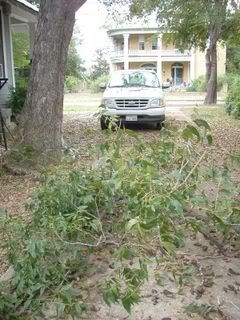
Monday morning I looked out the window. My truck was covered with pecans, leaves, and a couple of branches that’d snapped off the big pecan tree. There was also a huge branch stretched out on the drive, mortally felled by the rambunctious cold front which had muscled into town.

@@@@@@@@@@

I spent way too many hours early in the week engaged in a cursory edit of the Quinceañera I shot Saturday night. I’m turning the major editing over to someone else. But because I decided to use two cameras during the mass at the church, and seeing as I was jumping from one camera to another (repositioning each on its tripod), I knew there would be some real sloppy shots. I felt it was incumbent upon me to fix my own mess. I was using two Canon GL2s. And even though I set them both on the same white balance presets, they didn’t come out matching perfectly. I decided it was good enough, and concentrated on a simple picture edit, keeping the entire high mass in real time, with all it’s tedium. I pumped up the luminosity on a few clips. And even though I wasn’t given the opportunity to pull audio off a soundboard, I laid down the cleanest audio track the cameras picked up. I also managed to tone down the sound when it got too hot. (Actually, I had four different sound levels to chose from. A quick and dirty way to give yourself audio options to chose from is to set one channel (there are controls on the pricier camcorders for both left and right audio channels) higher than the other — so, with two cameras, that gave me four discreet channels to chose from … four choices of varying degrees of awfulness.)

One of the strange dynamics of editing video footage of real people (as opposed to actors playing roles) — such as interviews or things like weddings or Quinceañeras — is that you spend loads of time with these people. And you begin to connect with them.

It’s, of course, a wholly irrational situation. And you’ve got to keep in mind that you don’t know these people, and they don’t know you. The first time I was struck by the creepy transgressive nature of this line of work was when I was directing a video project maybe five years ago at UTA (when I first got into film and video production). It was a commercial video class, and the project was to produce a recruiting video for the graduate programs of the university. One of the interview subjects graciously made time for me and my crew of two. She was shy and unassuming. I sat beside the camera and interviewed her, telling her to ignore that soul-sucking machine with one glassy eye. Just look at me, I said. It’s just you and me talking.

And as artificial as that situation was, there quickly developed this rapport. There was this sense — well to me — of a deep intimacy. I’ve spoken to some of my photographer friends about this. They face the same dynamics when they do portraits. You connect … and it seems real. Actors, also, have to deal with this weird energy of intimacy (or pretend intimacy) all the time. Though for them it’s ten times worse, because they are absolutely vulnerable; whereas we — directors, cinematographers, photographers, editors — hell, we’re just voyeurs, usually with some sort of machine between us and the other.

What I discovered on my UTA project was that these feelings of connection I had during the interview process were intensified then I began editing the interview. I could see every nuance of expression. I could freeze the frame. I could stop and see an honest smile, play a genuine laugh over and over again. I could even pick out the occasional soft-footed skirting of the truth. Editors see all your lies.

There was this guy I interviewed — same project — from the biology department. Herpetologist. He was a dead-ringer for the actor Edward Norton. It wasn’t me who mentioned it, but one of my crew members. The snake guy laughed. It turned out he was a huge Edward Norton fan, and we weren’t the first to make the connection. While the camera was rolling, he gave us some really good Norton imitations. And later, as I was editing his interview, I had this unsettling feeling that were I to encounter him at a bar or a grocery store — even years later — I would walk up to him all enthusiastic and ask how he’s been … only to have him fearfully reel back, wondering who is this freak. Because, the truth is, thanks to the editing process, I’d spent loads more time with him that he spent with me. And I mean, hours.

I guess this is how it plays out when you subscribe to someone’s blog. Especially when it’s someone you’ve never met.

It’s hard, at times, to keep the real world separate from the virtual world.

Quinceañeras Still Give Color to Our Guantanamo World

For some reason, the newest neighbor in my little triplex house has fled. And I never learned her name. So, once again, it’s just me in this building. She’d mentioned something about a job offer in another city. I guess she took it. This situation allowed another opportunity for an unanticipated alarm clock to prod me from bed. Earlier in the week it was the street crews from the City of San Antonio. This time it was some outfit called Half Price Movers.

My neighbors, as well as those driving by, got a chance to see this woman’s furniture while the movers were Tetrising her belongings into the most efficient configuration within the moving van. She had pretty good taste. I pity those poor thieves driving by who had to get a taste of what could have been, but too late. Burglar’s remorse.

“Chet, slow it down, man.”

“Yeah, Jasper, I’m seeing it too.”

“Damn! Looks like she’s moving out.”

“Fuck me, Aunt Fritzi! Is that a Tiffany lampshade?”

“Good eye, Chet. Close. It’s Stueben — and it’s sweet.”

“Should we make a grab?”

“You crazy? Those Half Price Movers are tough hombres. They’ll fuck you up. Just drive, man.”

@@@@@@@@@@

She took her dryer with her. Dammit. However, the washing machine Alejandro and Lupita left behind for me is still working well enough. And actually, I prefer to hang my laundry out on the line.

So, this morning, as I waiting on the wash while catching up on Democracy Now via the internet, I heard a knock on my door. It was George Cisneros inviting me to Urban 15 for lunch. “It’s just tacos, but we need to catch up.”

I never turn down lunch with the Cisneros. They brought me up to speed. There are definitely things in the works over on the southside. I don’t know how much is ready for public disclosure, but I’m glad to see progress within the arts organizations in one of my favorite neighborhoods here in San
Antonio.

I was honored to be included, even peripherally, with this work.

But the main reason I was invited to lunch was for us all to talk about the best way to move the Josiah Youth Media Festival into its second year. The idea is to expand it. And to do that, we need to start early.

I keep trying to tell people that I’m not good at this sort of promotional crap. And I don’t enjoy it. However, what makes this different, is that I believe in the work that George and Catherine are doing. They’re wonderful people, and I value their friendship. I’ll keep working with them if they see a reason to keep working with me.

@@@@@@@@@@@

I now know my most recent former neighbor’s name. She’s didn’t forward her mail, so I can peek at what’s spilling out of her mailbox. Valerie. I knew it began with a V.

@@@@@@@@@@@

This weekend I shot a Quinceañera. It reminded me of when I first video-taped a wedding. It took me a while to get the swing of things because I’d really not been to a wedding before (leastwise, not a church wedding), and as such was clueless what goes on, and when. Quinceañera? I treated it like a wedding — just pointed the camera on the most over-dressed girl who is getting the most attention. Isn’t that also the key secret of the paparazzi?

At least it got me out of the house. I’ve been obsessively running through hours of video lectures on the TED.com site. People like Wade Davis, Jane Goodall, E. O. Wilson, Daniel Dennett, and their ilk. Two of my favorites were Erin McKean, a disarmingly witty lexicographer (editor in chief of The New Oxford American Dictionary) — and then there was James Howard Kunstler, author and social critic, whose talk, entitled, The Tragedy of Suburbia, viciously points out all the vapid, soulless nausea of contemporary trends in American architecture and city planning, such as suburbia, and other “places not worth caring about.” For those with slow internet connections, it appears that these short TED talks (each averaging 18 minutes) can also be accessed as audio files.

The Quinceañera didn’t end until midnight. There was lots of nothing to do. Like shooting a wedding, pretty much. There’s the ceremony. And later, the reception. The reception usually has a program of little, scattered events. But for the Quinceañera, like all those weddings I video-taped, the final two hours is nothing but people dancing to some lame DJ (but isn’t that a redundancy?). The first hour or two is kind of fun. Video-taping people dancing is a good cover for introverted social cripples (such as myself). You really have to get in there with the folks, move around with them, and not step on anyone’s feet. Because you’re the video guy — hiding behind an exotic camera rig — no one notices that you’re behaving like an ass, ’cause you’re making them all stars. But after you gather, say, an hour of folks dancing, it doesn’t really change. So, it’s time to stop. And wait. Wait for the whole affair to end.

What makes weddings different (well, most of them) is the alcohol. Maybe some kids were sneaking in some cough medicine this weekend, but it was mainly the slices of heavily frosted cake passed out around ten that kept them dancing until midnight.

The people were wonderful, but I don’t think I can do this sort of stuff any more. Ultimately, just like weddings, it involves me attending an event that I would never consider were it not presented as a job. And, really, I’m just not that driven by a buck. There was, for a time, an added component to the weddings. I was working for a local company. And there was always another video shooter at each gig. And often the company also provided the still photography. So we were there as a crew, and could more easily handle the down-time. For awhile I was actually fascinated by this subculture of the wedding industry. The veterans would be chummy with photogs from other companies. They also seemed to know all the local DJs. And often they were on first name terms with the pastors and priests of the local churches. Well, I think I managed to squeeze the fascination out of that peculiar industry after working in it — off and no — for about a year and a half. I did not want to become one of them.

There was a guy at the Quinceañera who I’d seen before. Well, not actually him, but his type … his tribe. It seems that every wedding (and perhaps Quinceañera) has a mentally handicapped relative who really loves to dance. I mean, when the music starts, these folks can’t stand still. They are great. They help to shame others to come up and dance during those more boring songs.

Photobucket - Video and Image Hosting

On the drive home I stopped to snap a photo of this neon sign advertising an extermination company.

@@@@@@@@@@

Tonight I dropped by the Jump-Start Performance Company for the last performance of “On the Island.” I’ve drifted away from reading the San Antonio Current (our free weekly guide to the local arts and cultural events, as it seems to have lost its edge and its relevance (if, indeed, it ever had these qualities)). And so, I manage to keep on top of local events through San Antonio bloggers from within the arts scene, email blasts, flyers at local coffee houses, and word-of-mouth. In fact, I knew about this Jump-Start show from a postcard displayed at Jupiter Java on S. Alamo. So, yes, this sort of promotion does work. It didn’t hurt that it was advertised as “written and performed by S. T. Shimi.” I’d seen Shimi at the Jump-Start’s anniversary party at the beginning of the year. She did a short ariel dance piece. And she also served as one of the Mistresses of Ceremonies … in the guise of Nicole Richie.

I’d almost forgotten all about it when I got a call from Russ. He read something about the piece and was interested in going.

Monessa Esquival (Jump-Start house manager, and one half of the Methane Sisters) was taking tickets. It was dead in the Blue Star Arts complex. And there were only two other people in the audience when me and Russ arrived. But by the time the show began, the audience beefed up considerably.

Michael Verdi sat down in front of me. I mentioned that I thought he was living in San Francisco. He said he was spending a lot of time traveling back and forth between these two San cities.

The show begins with Shimi behind two falls of drapery. They hang down from over the stage as a single loose rope. When doing the aerial parts of the piece, she can climb up, using it as one rope or two; loop the drapery around herself to swing in suspended contortions; or she can open up the cloth and use it as a flowing counterpart to the poetic narrative piece.

The “island” is, of course, Guantanamo. But Shimi breaks that theme open so as to play with greater concepts of isolation, subjugation, and incarceration. She often returns to a major narrative thread which features a playwright whose work (and the performance of that work) has become inexplicably subjected to torture (or, euphemistically, if you must, “stress positions”) … all played out to an audience of none. Much like our country’s torture chambers that apparently don’t exist. That tree falling in an uninhabited forest, making no sound.

It was a very powerful piece. Shimi’s athletic, graceful, and a great writer. I’m always impressed with one-person shows, because the performer is burdened with such a mountain of material. Shimi only faltered on one line. And that, only barely. She was climbing a bolt of turquoise Rayon at the time, as I recall.

I’ve said it before, the Jump-Start is the only San Antonio theater that consistently programs real art. Sad for San Antonio, but great for Jump-Start.